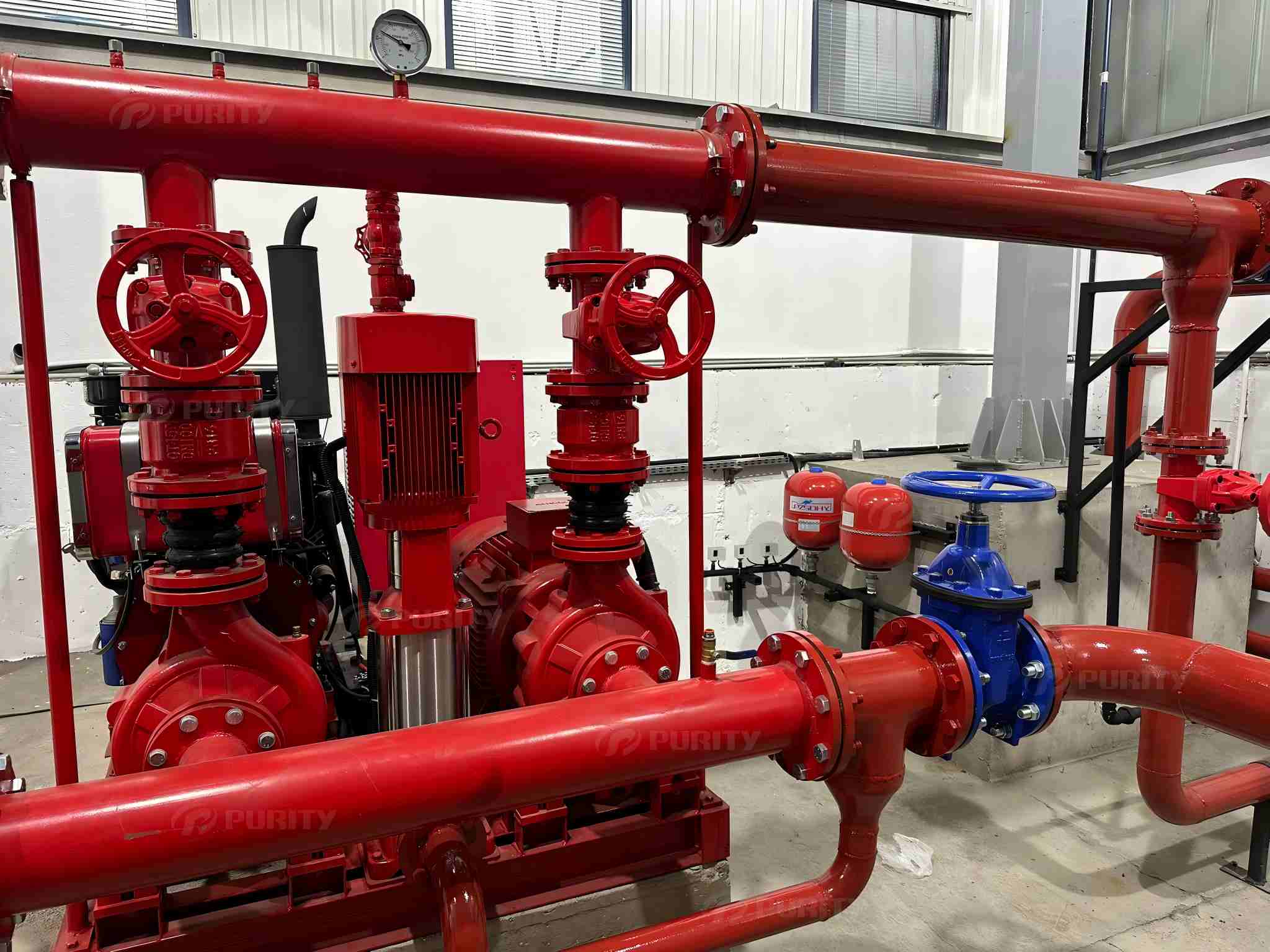
 Picture|Purity Fire Fighting Pump System PEDJ
A jockey pump, also known as a pressure maintenance pump, is a small pump used in fire protection systems to maintain system pressure and compensate for minor pressure losses.
Although much smaller than the main fire pump, a jockey pump plays an important role in keeping sprinkler, hydrant, and standpipe systems continuously pressurized and ready for an emergency.
When the pressure in a fire protection system drops slightly because of minor leakage or temperature changes, the jockey pump starts automatically to restore the pressure. Once the preset pressure is reached, it shuts down.
This prevents unnecessary starting of the main fire pump and helps keep the entire fire protection system reliable and ready for operation.
1. What Is the Role of a Jockey Pump?
Picture|Jockey Pump VS Main Fire Pump
The primary function of a jockey pump is to maintain pressure in a fire protection system.
A typical fire protection system includes a main fire pump designed to provide the high flow required during a fire. However, fire sprinkler and hydrant systems may experience small pressure losses even when there is no fire.
These losses can result from:
- · Minor leakage from valves, fittings, or piping
- · Temperature-related pressure changes
- · Small amounts of water loss during system testing
- · Normal pressure fluctuations within the piping network
Instead of allowing every small pressure drop to start the main fire pump, the jockey pump automatically restores system pressure.
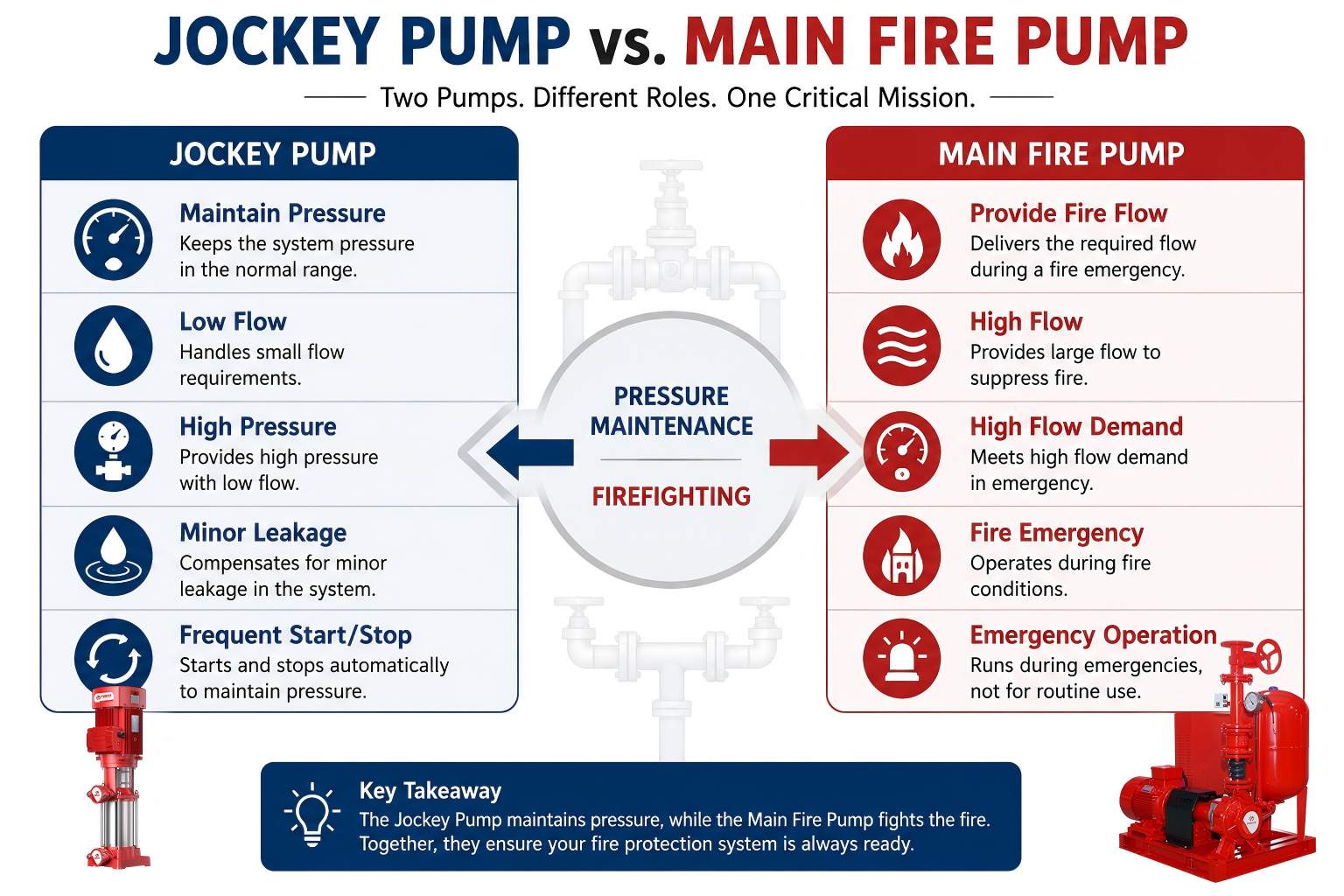
Jockey Pump vs. Main Fire Pump
The two pumps have different responsibilities:
|
Jockey Pump |
Main Fire Pump |
| Maintains system pressure | Supplies high flow during a fire |
| Low flow, relatively high pressure | High flow for fire protection demand |
| Handles minor pressure losses | Handles sprinkler/hydrant demand |
| Starts frequently when pressure drops | Starts when significant water demand occurs |
| Keeps the system pressurized | Provides the primary firefighting water supply |
In simple terms:
Jockey pump = maintains pressure
Main fire pump = supplies firefighting flow
This distinction is essential when designing and selecting a fire pump system.
2. How Does a Jockey Pump Work?
A jockey pump works automatically according to the pressure conditions in the fire protection system.
A typical operating sequence is:
System Pressure Drops
↓
Pressure Sensor Detects the Drop
↓
Jockey Pump Starts
↓
Pressure Is Restored
↓
Jockey Pump Stops
The pressure control settings are coordinated with the main fire pump so that the jockey pump responds to relatively small pressure losses while the main pump remains available for an actual fire demand.
Jockey pumps are commonly integrated with the fire pump control system and can operate automatically or manually depending on the system configuration.
What Does Frequent Jockey Pump Cycling Mean?
A jockey pump should not continuously start and stop under normal conditions.
If the pump cycles frequently, it may indicate:
- · A leak in the fire protection piping
- · A leaking valve
- · A faulty check valve
- · Improper pressure settings
- · Other pressure-loss problems within the system
Therefore, frequent jockey pump operation can serve as an early warning that the fire protection system needs inspection or maintenance.
3. Where Are Jockey Pumps Used?
Jockey pumps are commonly used in fire protection systems where maintaining stable system pressure is important.
Typical applications include:
- · High-rise buildings
- · Commercial buildings
- · Industrial facilities
- · Warehouses
- · Hospitals
- · Hotels
- · Shopping centers
- · Fire sprinkler systems
- · Fire hydrant systems
- · Standpipe systems
They are particularly useful in large or complex fire protection networks where even small pressure losses can cause unwanted changes in system pressure.
By maintaining the system at its normal pressure, the jockey pump helps reduce unnecessary starts of the main fire pump and supports the overall reliability of the fire protection system.
4. How to Size a Jockey Pump?
 Picture|Jockey Pump Guide
Proper jockey pump sizing is critical.
A jockey pump should be large enough to compensate for normal system leakage and minor pressure losses, but not so large that it can satisfy a significant fire flow demand.
If the jockey pump is oversized, it may delay the starting of the main fire pump when a real fire demand occurs. If it is undersized, it may not be able to maintain the required system pressure.
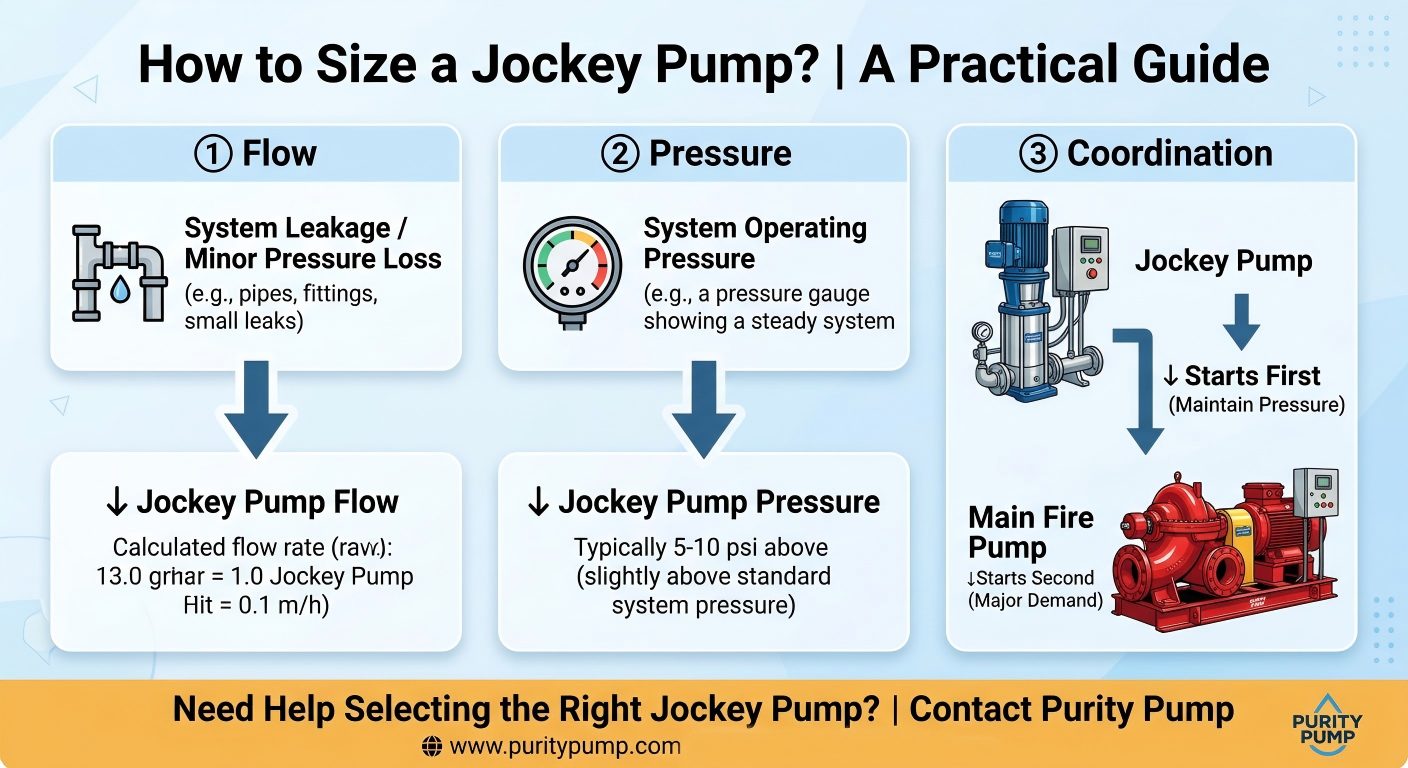
Jockey Pump Flow
The required flow depends on the design and leakage characteristics of the fire protection system.
For many systems, designers use the allowable leakage of the system as an important reference when determining jockey pump capacity. The pump should generally be capable of maintaining system pressure without supplying the flow required for actual firefighting.
Jockey Pump Pressure
The jockey pump should be selected with sufficient pressure to maintain the system at its normal operating pressure and coordinate properly with the pressure settings of the main fire pump.
A commonly used engineering rule of thumb is to select a jockey pump with a flow of approximately 1% of the rated flow of the main fire pump. However, this should be treated as a general sizing guideline rather than a universal requirement.
The final jockey pump selection should be based on the actual system design, allowable leakage, pressure requirements, elevation, piping configuration, and applicable fire protection standards.
Why Correct Sizing Matters
Correct sizing helps ensure that:
Minor pressure loss → Jockey pump starts
Normal pressure restored → Jockey pump stops
Major water demand/fire → Main fire pump starts
This coordinated operation helps prevent unnecessary main fire pump starts while ensuring that the fire protection system can respond properly when needed.
5. Why Is a Jockey Pump Important?
The jockey pump may be small compared with the main fire pump, but its role in maintaining fire system readiness is significant.
1. Maintains System Pressure
It keeps the fire sprinkler and hydrant network at the required standby pressure.
2. Prevents Unnecessary Main Pump Starts
Small pressure losses can be corrected without starting the main fire pump.
3. Helps Reduce Pump Wear
By minimizing unnecessary main pump starts, the jockey pump can help reduce mechanical and electrical stress on the main fire pump system.
4. Helps Identify System Leakage
Abnormally frequent jockey pump starts may indicate leakage or other problems that require investigation.
5. Keeps the System Ready
Maintaining the correct standby pressure ensures that the fire protection system remains prepared for emergency operation.
6. Purity Jockey Pump: Designed for Reliable Pressure Maintenance
 Picture|Purity Jockey Pump
For fire protection applications, a jockey pump needs to provide stable pressure, reliable operation, and long service life.
The Purity jockey pump is designed to meet these requirements with a focus on hydraulic performance and durability.
Efficient Hydraulic Design
The optimized hydraulic design helps provide stable pressure performance while supporting efficient operation.
Durable Mechanical Components
Wear-resistant mechanical seals and reliable bearings are designed to improve durability and help reduce the risk of leakage during long-term operation.
Reliable Pressure Maintenance
With appropriate pressure control and fire pump system integration, the Purity jockey pump can continuously compensate for minor pressure losses and help keep fire protection systems ready for operation.
7. Jockey Pump FAQs
Is a jockey pump a fire pump?
Yes. A jockey pump is a component of a fire protection pumping system, but it is not the primary pump used to supply firefighting flow. Its main purpose is to maintain system pressure.
Does a jockey pump run continuously?
No. Under normal conditions, the jockey pump starts automatically when system pressure falls below its start setting and stops after pressure is restored.
Why does my jockey pump keep starting?
Frequent starts may indicate a leak, faulty valve, pressure fluctuation, incorrect pressure settings, or another problem within the fire protection system. The cause should be investigated rather than simply increasing the pump size.
Can a jockey pump replace the main fire pump?
No. A jockey pump is designed for pressure maintenance and minor water losses. It is not designed to provide the high flow required during a fire.
How do I choose the right jockey pump?
Selection should consider:
- · Required system pressure
- · Allowable leakage
- · Main fire pump rated flow
- · Building height and elevation
- · Piping configuration
- · Sprinkler and hydrant requirements
- · Applicable fire protection standards
- · Local code and authority requirements
For a complete fire pump system, the jockey pump should be selected and coordinated with the main fire pump and its control system.
Conclusion
A jockey pump is a pressure-maintenance pump that keeps a fire protection system pressurized and ready for an emergency.
Its primary job is not to fight the fire, but to compensate for minor pressure losses so that the main fire pump does not start unnecessarily.
A properly selected jockey pump helps maintain stable system pressure, reduce unnecessary main pump starts, identify potential leakage problems, and improve the overall reliability of a fire protection system.
For reliable fire protection solutions, choosing the right combination of jockey pump, main fire pump, controller, and pressure settings is essential.
Looking for a reliable jockey pump for your fire protection project? Contact Purity Pump for professional pump selection and fire protection solutions
Post time: Jul-03-2024