
In modern fire protection systems, the correct sequencing between pumps is not a design preference—it is a critical safety requirement. One of the most important principles in fire pump system design is that the jockey pump must always start before the fire pump. This ensures system stability, prevents unnecessary main pump operation, and guarantees reliable emergency response when a real fire occurs.
A fire pump jockey (also called a pressure maintenance pump or jockey pump fire system component) plays a small but essential role in maintaining constant pressure inside fire protection pipelines. Although it is much smaller than the main fire pump, its function directly impacts the efficiency and lifespan of the entire system.
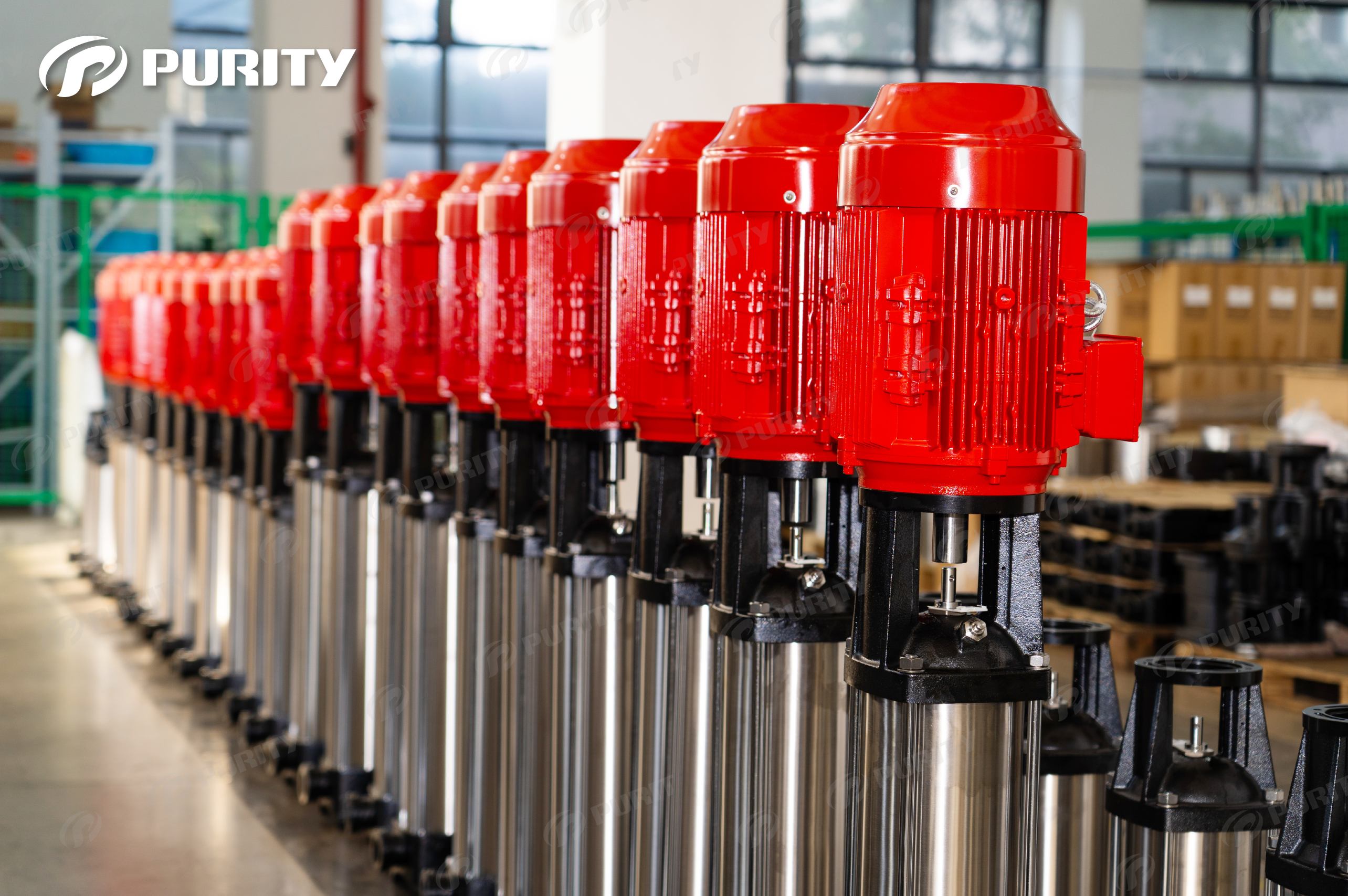
Picture | Purity Vertical Multistage Pump (PVS)
The core role of a jockey pump in a fire protection system
A jockey pump fire pump system is designed to maintain stable water pressure in sprinkler networks, hydrants, and standpipes when the system is not actively discharging water. Because piping networks naturally experience minor leaks, temperature-related expansion, or pressure losses, small fluctuations occur constantly.
Without a jockey pump for fire pump systems, these minor pressure drops would continuously trigger the main fire pump. This is inefficient and potentially damaging.
The jockey pump solves this problem by:
(1)Automatically restoring small pressure losses
(2)Keeping the system at a stable standby pressure
(3)Preventing unnecessary activation of the main fire pump
In simple terms, the jockey pump is the “pressure guardian” of the entire fire system.
Why the jockey pump must start first
The reason is based on a simple but critical control logic:
Small pressure drop → jockey pump starts
Large pressure drop → main fire pump starts
This sequence ensures that the main fire pump is reserved only for real fire emergencies.
If this order is not followed, even small leaks or normal pressure variations would activate the main fire pump. This leads to serious operational problems.
1. Prevents unnecessary fire pump activation
The jockey pump fire pump handles minor pressure fluctuations that occur daily. Without it, the main fire pump would start frequently due to:
(1)Micro-leaks in pipelines
(2)Temperature changes
(3)System testing activities
(4)Valve seepage
Frequent operation of the main fire pump causes:
(1)Mechanical wear and tear
(2)Higher maintenance costs
(3)Increased energy consumption
(4)Reduced system reliability
By ensuring the jockey pump starts first, the system avoids unnecessary stress on the main fire pump.
2. Ensures correct emergency response behavior
A properly designed jockey pump fire system guarantees that only real fire conditions trigger the main pump.
When a sprinkler head opens during a fire, a significant pressure drop occurs. The jockey pump cannot compensate for this large demand, so the main fire pump activates automatically.
This separation ensures:
(1)Jockey pump → handles minor pressure changes
(2)Fire pump → handles real fire events
This clear division of roles is essential for life safety systems.
3. Improves system stability and reduces water hammer
Rapid or frequent activation of the main fire pump can cause water hammer—a dangerous pressure surge inside pipes. This may result in:
(1)Pipe damage
(2)Valve failure
(3)System fatigue
(4)Reduced service life
A properly configured jockey pump for fire pump systems maintains steady pressure, reducing sudden hydraulic shocks and improving long-term reliability.
4. Supports NFPA-based fire safety design
International standards such as NFPA 20 require pressure maintenance pumps in fire protection systems. The jockey pump fire pump is not optional—it is part of a compliant system design.
Proper configuration ensures:
(1)Stable standby pressure
(2)Correct pump sequencing
(3)Reliable emergency operation
(4)Compliance with inspection standards
5. Optimized design and system efficiency
Modern jockey pumps are engineered for precision control rather than high flow. Typical design features include:
(1)Very low flow rate (about 1% of main pump capacity)
(2)High-accuracy pressure control
(3)Compact centrifugal or multistage design
Advanced models, such as Purity PVE jockey pumps, use hydraulic optimization to improve efficiency. Key improvements include:
(1)Up to 10–30% higher head performance under the same conditions
(2)Around 20% noise reduction through impeller optimization
(3)Improved energy efficiency through hydraulic simulation design
These improvements make the jockey pump fire pump system more stable and efficient in long-term operation.

Picture | Purity Vertical Multistage Pump PVE
6. System reliability and configuration requirements
A correctly installed jockey pump for fire pump must include:
(1)Independent pressure sensing line
(2)Dedicated controller system
(3)Check valves and isolation valves
(4)Proper pressure differential settings
The pressure setting must ensure:
(1)Jockey pump starts at higher pressure
(2)Fire pump starts at lower pressure
This hierarchy guarantees stable system behavior and prevents overlapping pump activation.
Conclusion
The reason why the jockey pump must start before the fire pump is fundamentally about control, protection, and reliability. The jockey pump fire system ensures that small pressure losses are managed locally, while the main fire pump is reserved strictly for emergency conditions.
By working together, the fire pump jockey, jockey pump fire, and jockey pump for fire pump systems create a layered pressure control mechanism that improves safety, reduces mechanical wear, and ensures compliance with global fire protection standards.
Ultimately, the jockey pump is not a secondary component—it is the foundation of a stable and reliable fire pump system.
Post time: May-19-2026


