Picture|Sewage Pump Selection Guide
Choosing the right sewage pump is important for reliable wastewater transfer in residential buildings, hotels, commercial facilities, municipal systems, and industrial applications. A properly selected pump can help reduce clogging, energy consumption, maintenance costs, and unexpected downtime.
However, choosing a sewage pump is not simply about selecting the largest flow rate or highest motor power. Different wastewater conditions require different pump designs. Solids content, flow rate, total head, pump type, motor configuration, and materials should all be considered before making a decision.
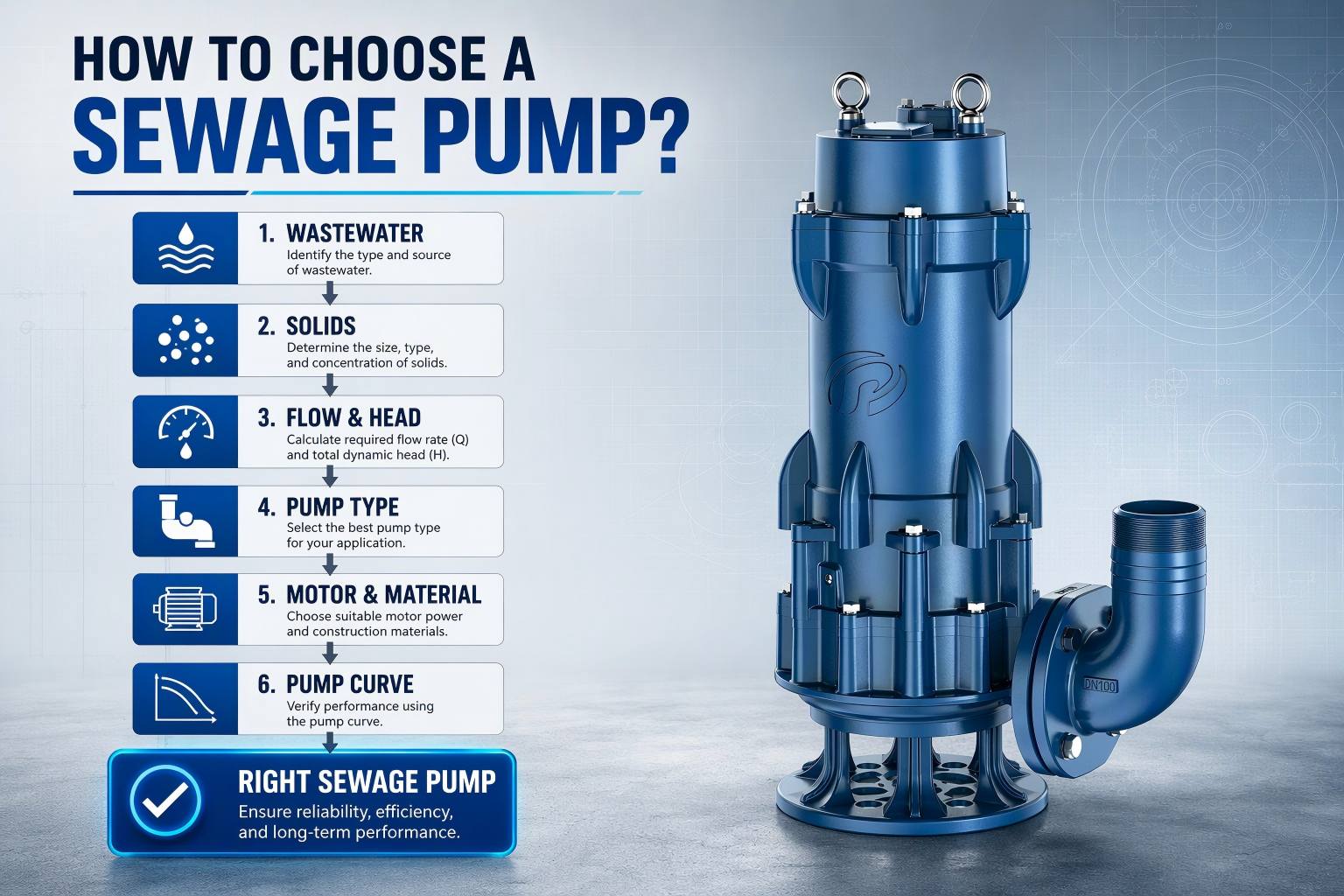
A practical selection process is:
Wastewater → Solids → Flow → Head → Pump Type → Motor & Material → Pump Curve
1. Understand the Wastewater First
Before selecting a sewage pump, the first step is to understand the wastewater that needs to be transferred.
Domestic wastewater from homes, hotels, and commercial buildings may contain suspended solids, wipes, fibers, and other debris. Industrial wastewater can be more complex and may contain larger particles, long fibers, or abrasive and corrosive substances.
Important questions include:
1. Does the wastewater contain solid particles?
2. What is the maximum solids size?
3. Does it contain long fibers or materials that may cause clogging?
4. Is the wastewater abrasive or corrosive?
5. How frequently will the pump operate?
These factors affect the impeller design, free passage, pump materials, sealing system, and motor configuration.
For wastewater collected in a sump or basin, a submersible sewage pump is often a practical solution. Because the pump operates directly in the wastewater, sewage submersible pumps can be used in many wastewater collection and transfer systems without requiring a separate dry-pump installation.
2. Select the Right Sewage Pump Type
Picture|Channel Impeller vs. Vortex Impeller
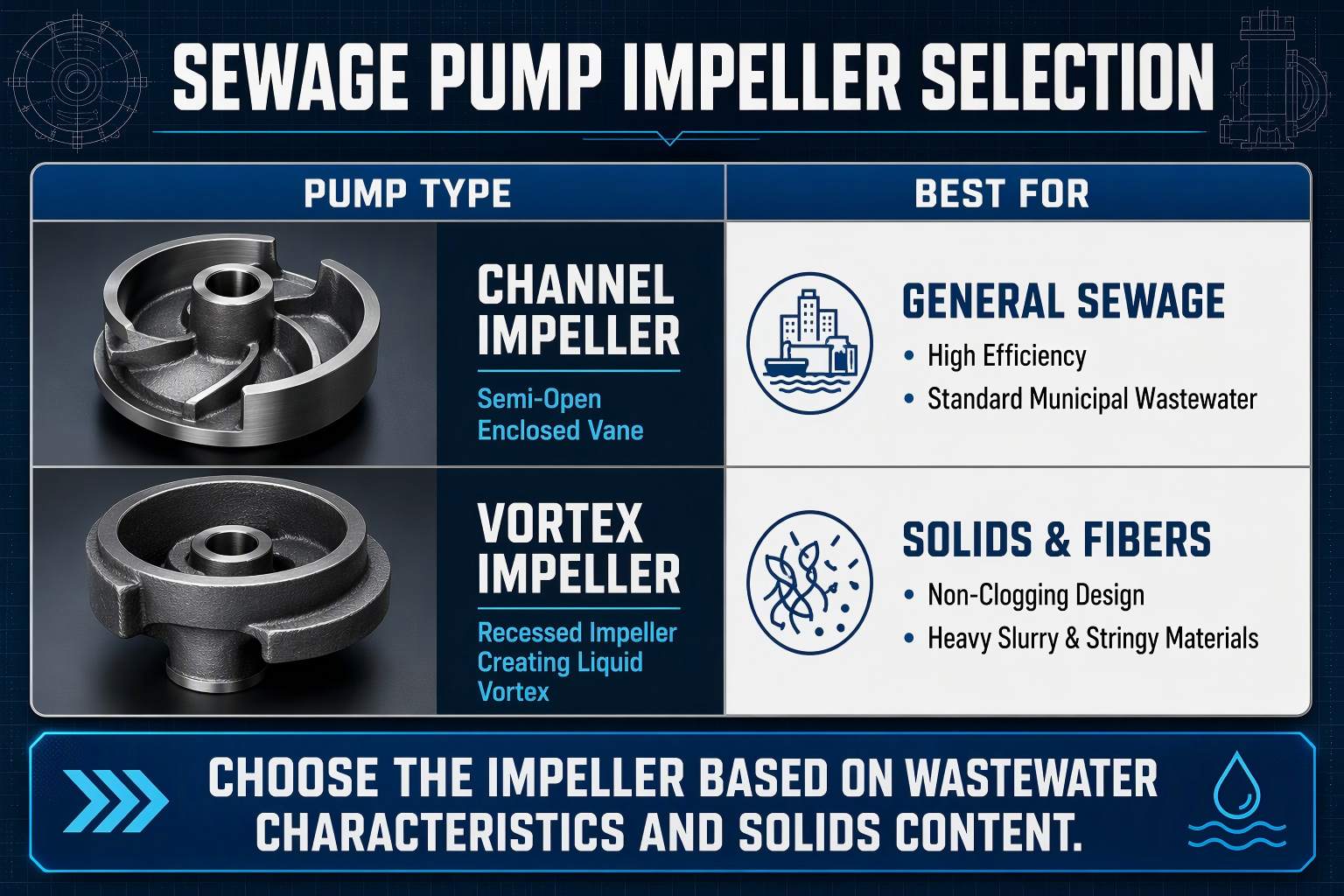
Different sewage pumps use different impeller designs to handle specific wastewater conditions.
Channel Impeller Pump
A channel impeller pump is commonly used for relatively normal wastewater applications. Its hydraulic passage provides good flow performance when the solids and debris can pass through the pump within the specified free-passage capacity.
Vortex Impeller Pump
A vortex impeller pump is suitable for wastewater containing solids, fibers, and other debris. Its vortex design reduces direct contact between solids and the impeller, which can help reduce the risk of clogging.
Therefore, there is no single “best” sewage pump for every application. The right choice depends on whether the pump design matches the actual wastewater characteristics and operating conditions.
Purity provides WQ series submersible sewage pumps for different wastewater applications. The appropriate model can be selected according to flow, head, solids-handling requirements, and installation conditions.
3. Determine Flow Rate and Total Head
Picture|Sewage Pump TDH
After understanding the wastewater and selecting a suitable pump type, the next step is to determine the required flow rate and head.
Flow rate indicates how much wastewater the pump needs to transfer within a specific period. Common units include m³/h and GPM.
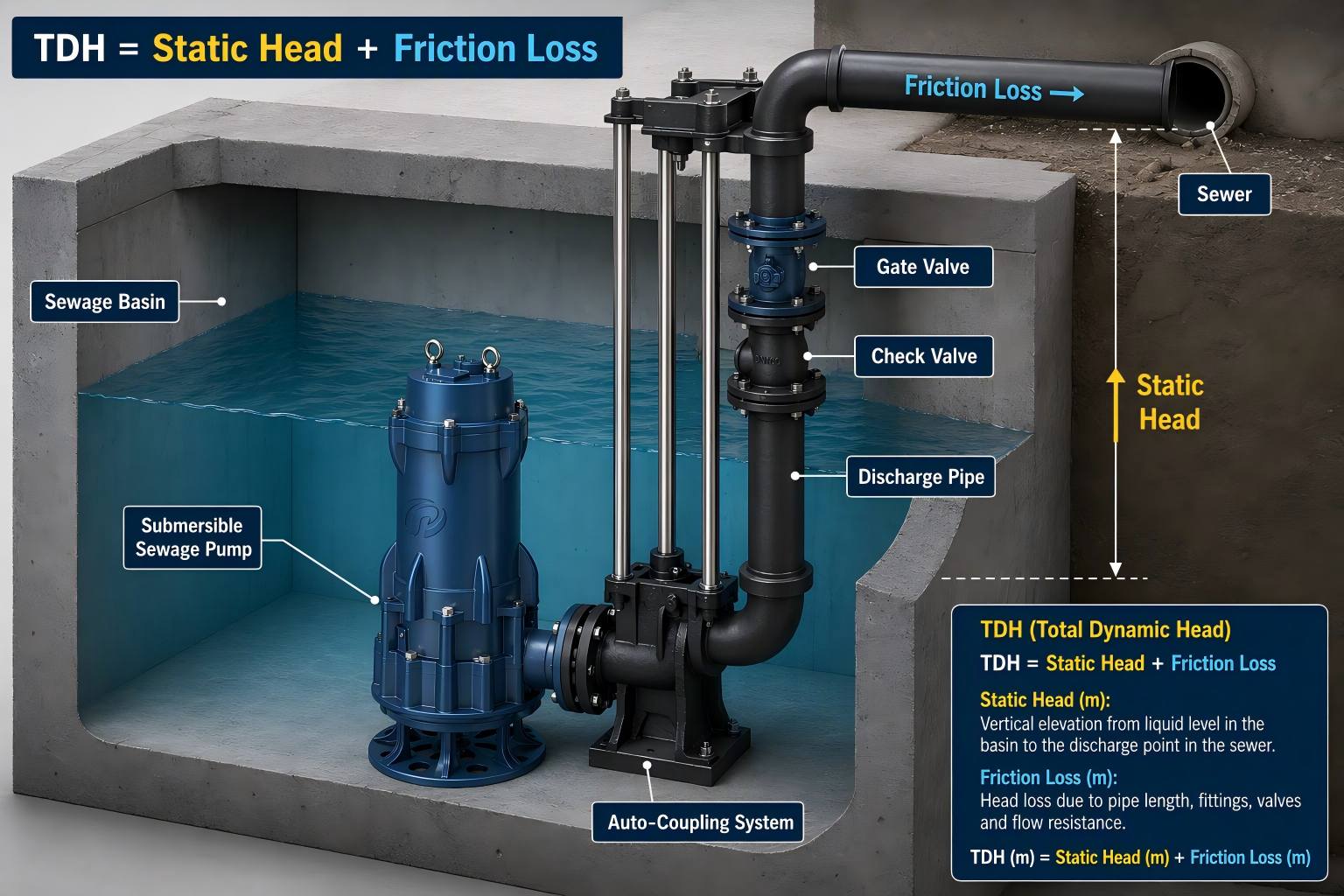
Head represents the pressure required to move wastewater through the entire system. It includes the vertical lifting height as well as friction losses from pipes, elbows, valves, and other components.
Therefore, pump selection should consider Total Dynamic Head (TDH) rather than vertical height alone.
A simple calculation concept is:
Static Head + Friction Loss = Total Dynamic Head
The selection process should then be:
Required Flow + Required Head → Check Pump Curve → Select Pump
Choosing a pump with excessive flow or head may result in inefficient operation, higher energy consumption, or unnecessary motor load.
4. Check Free Passage, Motor and Materials
For sewage applications, Free Passage is an important specification. It indicates the maximum solid size that can pass through the pump. The free passage should be suitable for the actual solids found in the wastewater.
Material selection is also important. Cast iron is widely used for many conventional and heavy-duty wastewater applications, while stainless steel can provide better corrosion resistance in demanding environments.
Motor reliability is equally important, especially for submersible sewage pumps designed for long-term operation. Key specifications include motor power, single-phase or three-phase configuration, operating voltage, thermal protection, and sealing performance.
Purity’s WQ submersible sewage pump incorporates several design features for demanding operating conditions. Its stainless steel welded shaft helps improve durability and service life. The full-head design provides a wider usable operating range, helping reduce the risk of motor damage caused by improper pump selection. In addition, its ultra-wide voltage operation helps address starting difficulties and excessive temperature rise caused by voltage drops or unstable power conditions.
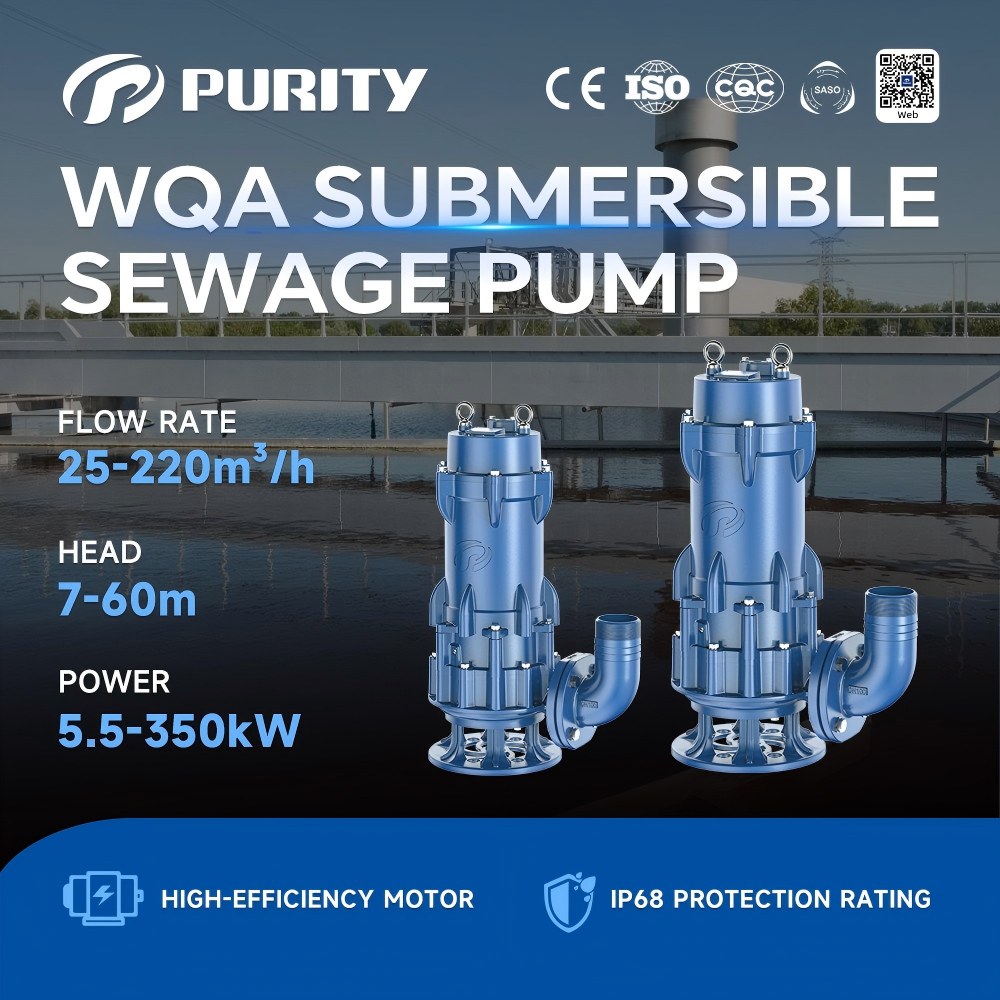
Picture|Submersible Sewage Pump WQ
These features can be particularly valuable in wastewater systems where reliable operation and stable performance are important.
5. Consider Total Cost of Ownership
The purchase price is only one part of the cost of owning a sewage pump. For equipment that operates frequently or continuously, it is important to consider the total cost over its service life.
A useful way to evaluate the overall cost is:
Energy Consumption + Maintenance + Spare Parts + Service Life + Downtime = Total Cost of Ownership
A lower-priced pump may become more expensive over time if it consumes more energy, requires frequent maintenance, or has a shorter service life.
When choosing a sewage pump manufacturer, consider manufacturing experience, product quality, technical support, spare-parts availability, certifications, and after-sales service.
With more than 16 years of pump manufacturing experience, Purity provides sewage pump and industrial fluid-transfer solutions for different flow, head, wastewater, and operating requirements.
Conclusion
Choosing the right sewage pump starts with understanding the wastewater and its solids content. Then determine the required flow rate and total head before selecting the appropriate pump type, impeller, motor, and materials.
The key selection formula is:
Wastewater → Solids → Flow → Head → Pump Type → Motor & Material → Pump Curve
Whether you need a standard sewage pump, a submersible sewage pump, or other sewage submersible pumps, the goal is to match the pump with the actual working conditions rather than simply choosing the largest or most powerful model.
For complex wastewater applications, professional pump selection based on actual operating conditions can help improve reliability, efficiency, and long-term performance.
Post time: Oct-08-2026