
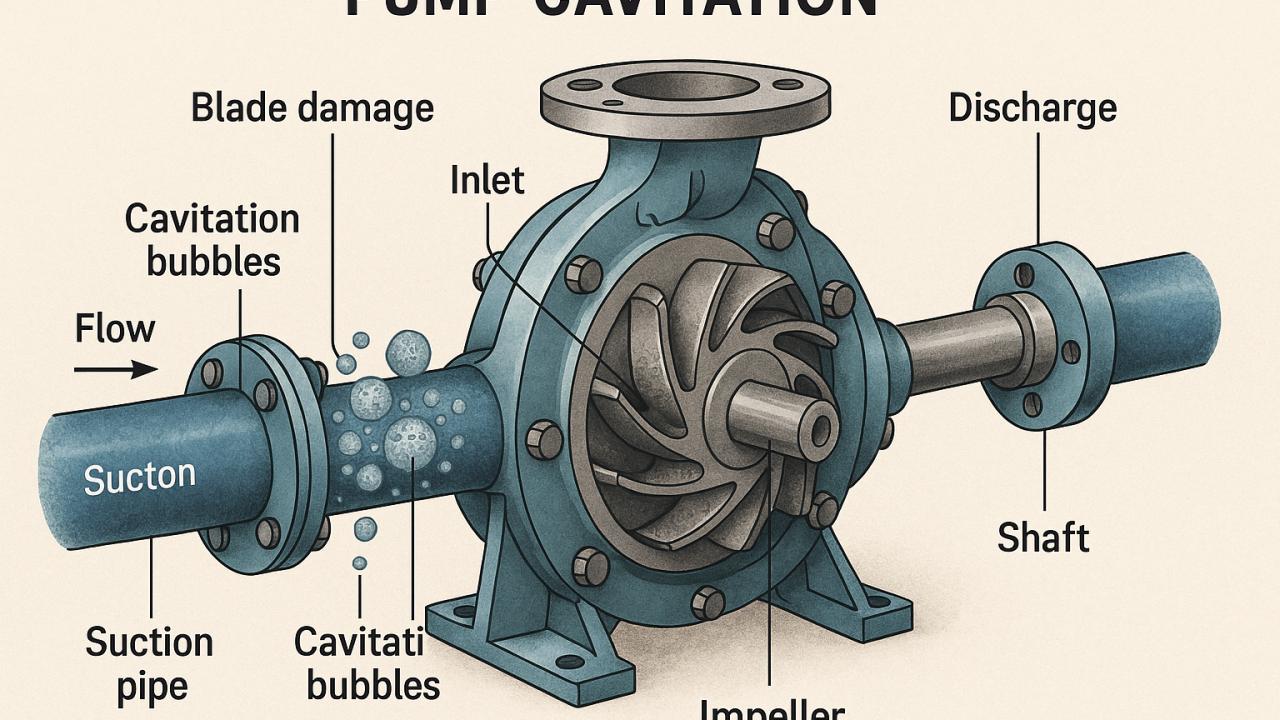
 Picture|Conceptual diagram of centrifugal pump cavitation
If you have ever stood next to a running centrifugal pump and heard a sound resembling gravel or marbles rattling around inside the casing, you have witnessed one of the most destructive phenomena in fluid mechanics: cavitation. Left unchecked, cavitation can erode a brand-new impeller in weeks, destroy mechanical seals, and ultimately lead to catastrophic pump failure.
In this article, we break down the physics behind cavitation, explain how to identify it before it causes major damage, and provide proven engineering strategies to eliminate it from your pumping system.
1. What Is Cavitation? The Physics Explained
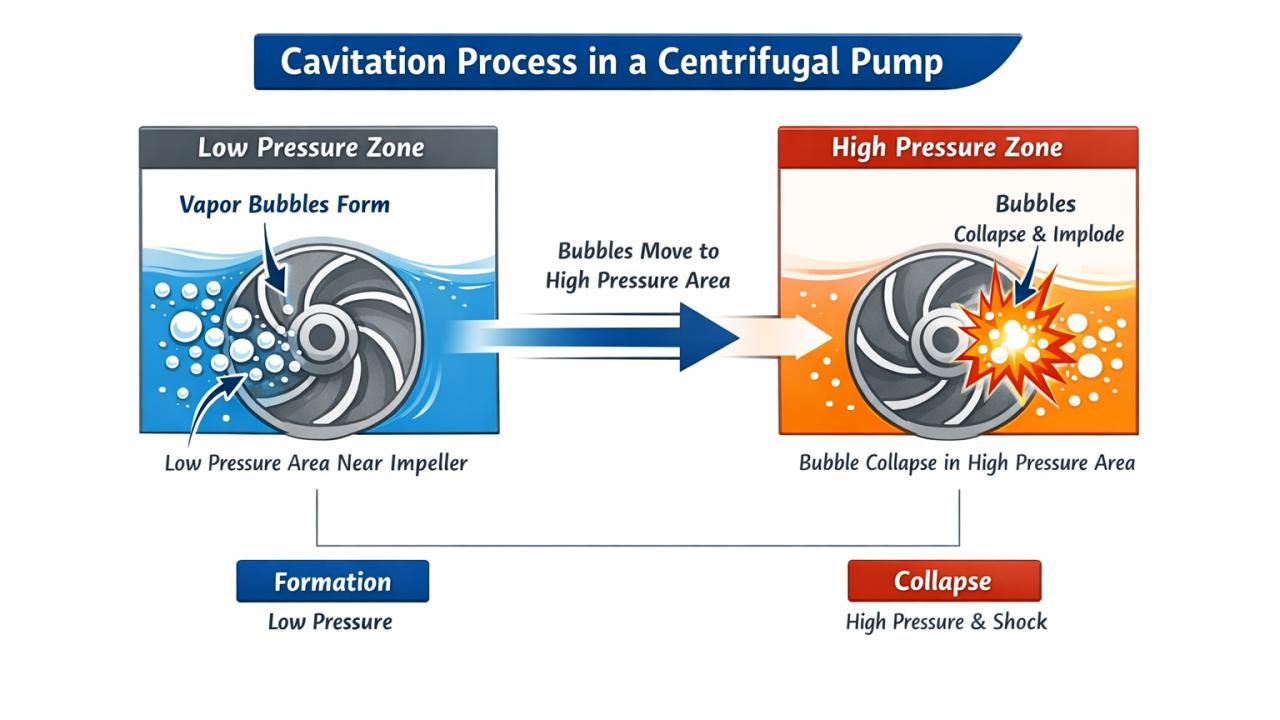 Picture|The formation process of cavitation in centrifugal pumps
Cavitation is the formation and subsequent violent collapse of vapor bubbles inside a liquid being pumped. It occurs when the pressure at any point inside the pump drops below the liquid’s vapor pressure — the pressure at which a liquid begins to boil at its current temperature.
Here is the chain of events, step by step:
(1)Pressure Drop: As fluid accelerates into the impeller eye, its pressure drops significantly (Bernoulli’s principle).
(2)Bubble Formation: If the local pressure falls below the vapor pressure of the liquid, tiny vapor-filled cavities (bubbles) form spontaneously.
(3)Bubble Collapse: These bubbles are carried along the impeller vanes into a region of higher pressure. The surrounding liquid rushes in and crushes the bubbles with immense force — often exceeding thousands of atmospheres at a microscopic scale.
(4)Surface Damage: The implosion creates micro-jets that strike the impeller and casing surface, physically tearing away metal particles. Over time, this produces the characteristic “pitted” or “sponge-like” appearance on the impeller.
2. What Causes Cavitation? The NPSH Equation
The root cause of cavitation is simple: the pump’s Net Positive Suction Head Available (NPSHa) is insufficient relative to its Net Positive Suction Head Required (NPSHr).
1.NPSHa: The absolute pressure head available at the pump suction, after subtracting the liquid’s vapor pressure. This is determined by your system design — tank elevation, atmospheric pressure, pipe friction losses, and fluid temperature.
2.NPSHr: The minimum pressure head the pump requires at its suction to avoid cavitation. This is a characteristic of the pump itself, provided by the manufacturer on the performance curve.
The golden rule: NPSHa must always exceed NPSHr by a safety margin (typically a minimum of 0.5 to 1.0 meter).
(1) Common system-side causes that reduce NPSHa include:
(2) The supply tank is located too low relative to the pump.
(3) The suction pipe diameter is too small, causing excessive friction loss.
(4) A clogged suction strainer or partially closed valve restricts flow.
(5) The pumped fluid is too hot, raising its vapor pressure and shrinking the NPSHa margin.
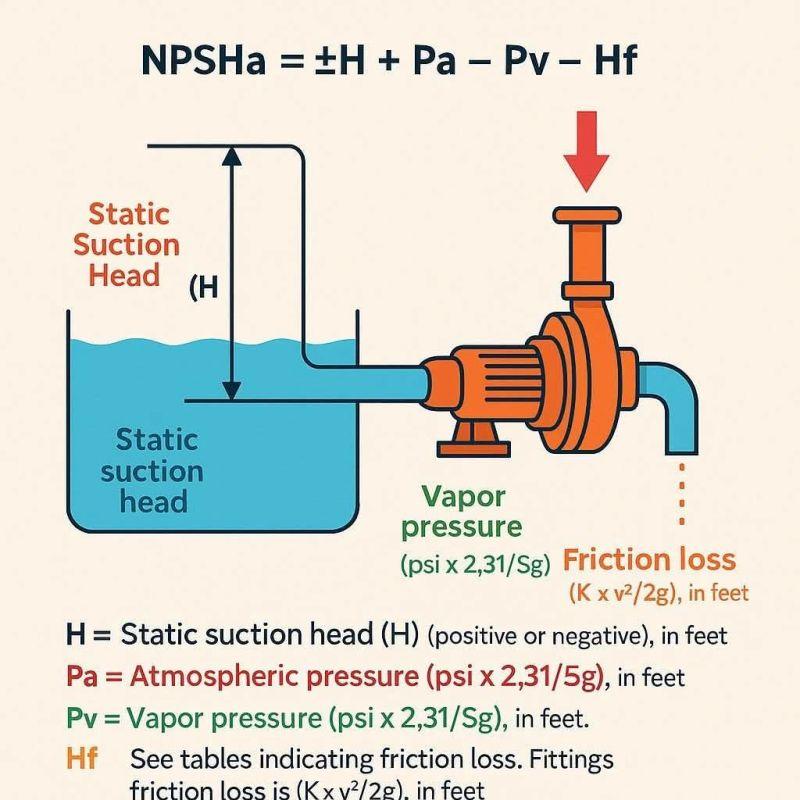
Picture|NPSHa vs NPSHr
3. How to Recognize Cavitation: Three Warning Signs
Identifying cavitation early can save tens of thousands of dollars in repair costs. Watch for these three telltale indicators:
| Symptom | What It Indicates |
| Rattling / Gravel-like Noise | Vapor bubbles collapsing violently inside the pump. This is the most distinctive early warning sign. |
| Excessive Vibration | Unstable flow caused by uneven bubble collapse disrupts the impeller’s hydraulic balance, shaking the pump and connected piping. |
| Pitting on the Impeller Surface | Physical inspection reveals a rough, cratered surface — especially near the impeller vane tips and eye — resembling corrosion but caused purely by mechanical impact. |
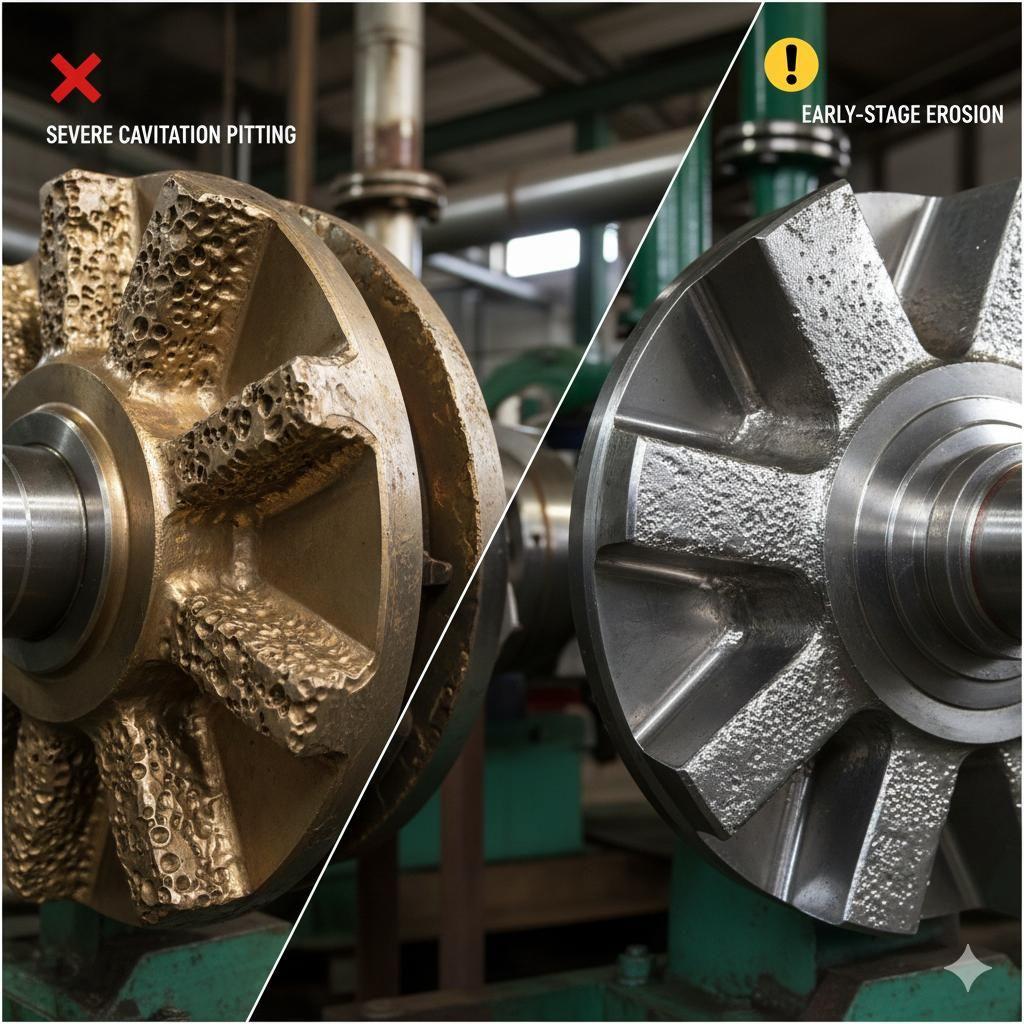 Normal Impeller vs. Cavitation-Damaged Impeller
4. Five Proven Strategies to Prevent Cavitation
Preventing cavitation is almost always cheaper than repairing its consequences. Here are five engineering solutions, ranked from simplest to most involved:
1.Increase Suction Pipe Diameter: A larger pipe cross-section reduces fluid velocity and friction loss, maintaining higher NPSHa at the pump inlet. This is often the cheapest and most effective fix.
2.Lower the Pump Elevation: Installing the pump closer to, or even below, the supply liquid level increases the static head available at the suction — directly boosting NPSHa.
3.Reduce Fluid Temperature: Cooler liquid has a lower vapor pressure, widening the gap between NPSHa and NPSHr. If your process allows it, lowering temperature by even 5–10°C can make a significant difference.
4.Select a Pump with a Lower NPSHr: Some pump designs — such as those with double-suction impellers or a larger impeller eye diameter — have inherently lower NPSHr values. When specifying a new pump, make NPSHr a key selection criterion.
5.Install a Variable Frequency Drive (VFD): A VFD allows you to reduce pump speed. Since NPSHr decreases with the square of the speed, even a modest 10–15% speed reduction can dramatically improve cavitation margins.
5. Frequently Asked Questions
Q: Can cavitation occur in a pump handling cold water?
A: Yes. Cavitation depends on pressure, not just temperature. Even cold water at 20°C will cavitate if the suction pressure drops below approximately 2.3 kPa (absolute) — a condition easily reached with poor suction piping design.
Q: Is cavitation damage the same as corrosion?
A: No, although they look similar. Cavitation is purely mechanical — microscopic implosions physically erode the metal. Corrosion is a chemical reaction between the metal and the fluid. However, cavitation damage often accelerates corrosion by stripping away protective oxide layers.
Q: How do I calculate NPSHa for my system?
A: The basic formula is: NPSHa = Ha ± Hz − Hf − Hvp, where Ha is atmospheric pressure head, Hz is the elevation difference between the supply level and pump centerline (+ if supply is above the pump), Hf is friction loss in the suction piping, and Hvp is the vapor pressure head of the fluid at its operating temperature. Always add a safety margin of at least 0.5 m.
Protect Your Pump Infrastructure with Purity Pump
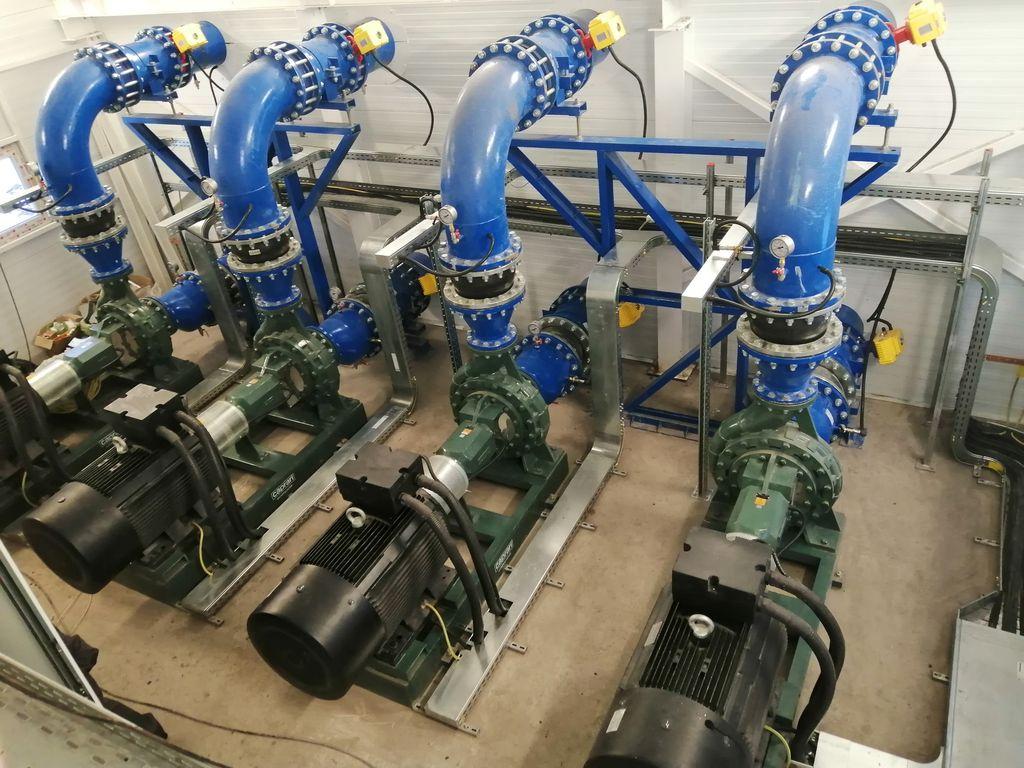
Picture | Purity PSM End-Suction Centrifugal Pump Case Study
At Purity Pump , we engineer centrifugal pumps with optimized hydraulic designs that deliver low NPSHr values — meaning wider cavitation-free operating windows for your systems. From double-suction split case pumps for municipal water supply to multistage pumps for high-rise buildings, our ISO-certified products serve over 130 countries with industry-leading reliability.
Contact Purity Pump’s engineering team to request NPSHr curve data, a custom cavitation analysis, or technical support for your existing pump system.
Post time: Jul-15-2026


