
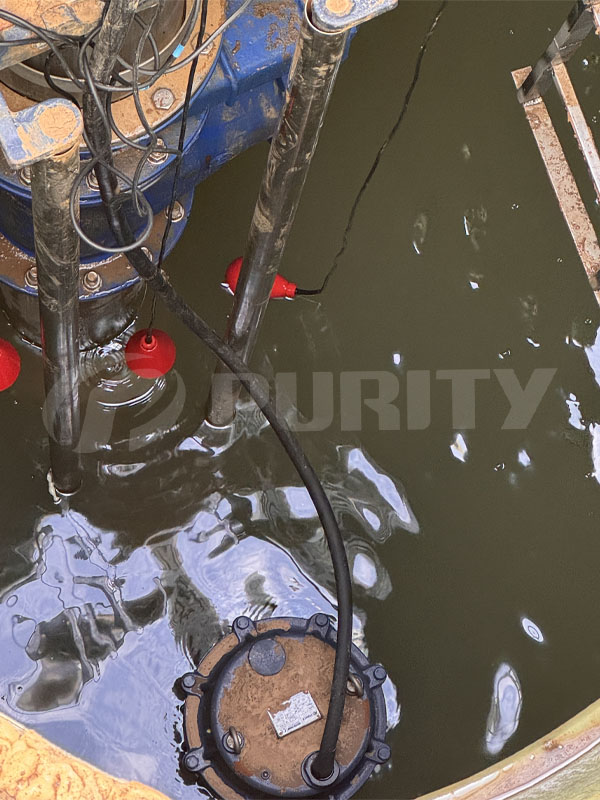
Picture | Purity WQ Series Sewage Pump Application Case
A submersible sewage pump works in one of the harshest environments imaginable — fully submerged in wastewater containing solids, fibers, and often corrosive chemicals. When these pumps fail, the consequences are immediate and costly: backed-up sewage, flooded pump stations, and emergency repair bills.
The good news is that most pump failures do not happen without warning. By recognizing the early symptoms and understanding their root causes, maintenance teams can resolve issues before they escalate into catastrophic breakdowns. This guide covers the six most common submersible sewage pump problems, their likely causes, and actionable fixes.
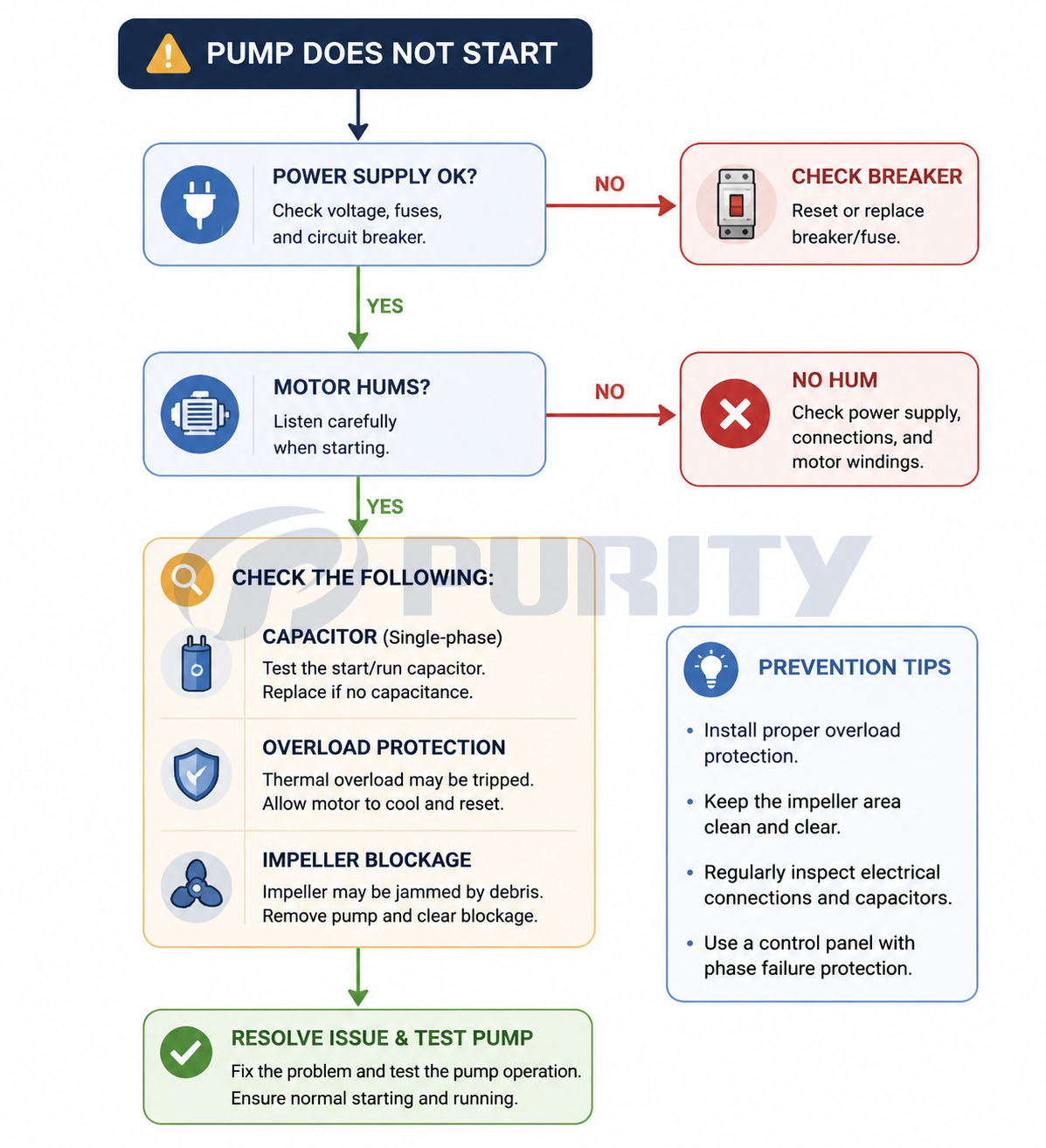
1. Pump Won’t Start or Hums Without Running
 Picture |Submersible Sewage Pump Troubleshooting
Symptoms: You press the start button and nothing happens — or the pump emits a humming sound but the impeller does not rotate.
Common Causes & Fixes:
| Cause | Solution |
| Tripped circuit breaker or blown fuse | Reset the breaker; if it trips again, check for a short circuit or overload condition |
| Thermal overload protection activated | Allow the motor to cool for 30 minutes; investigate why it overheated before restarting |
| Impeller jammed by debris | Disconnect power, remove the pump, and manually clear the blockage from the impeller |
| Faulty capacitor (single-phase motors) | Test and replace the start/run capacitor if it shows no capacitance |
Prevention: Install a control panel with phase-failure and overload protection to catch electrical issues before they damage the motor.
2. Pump Runs but Delivers No Water
Symptoms: The motor spins, but no wastewater discharges through the outlet pipe.
Common Causes & Fixes:
| Cause | Solution |
| Air-locked pump casing | Vent the air from the pump volute through the air-release plug or by briefly lifting and re-submerging the pump |
| Clogged suction inlet or strainer | Clean the suction screen; if clogging recurs, consider a pump with a wider solids-handling passage |
| Closed or stuck check valve | Inspect the discharge check valve — replace if the flapper is seized or blocked |
| Incorrect motor rotation (3-phase) | Swap any two of the three power leads to reverse rotation direction |
Prevention: Conduct a monthly visual inspection of the suction screen and test check valve operation quarterly.
3. Frequent Clogging Despite Regular Operation
Symptoms: The pump requires manual unclogging every few days, causing repeated downtime.
Root Causes:
The pump’s solid-handling diameter is undersized for the actual solids in the waste stream
The impeller type is wrong for the application (e.g., a closed impeller in fibrous wastewater)
Solutions:
Upgrade to a pump with a larger solids-passing capacity — at minimum 50 mm for municipal sewage
Switch to a vortex impeller design, which creates a swirling action that carries solids through without direct contact with the impeller blades
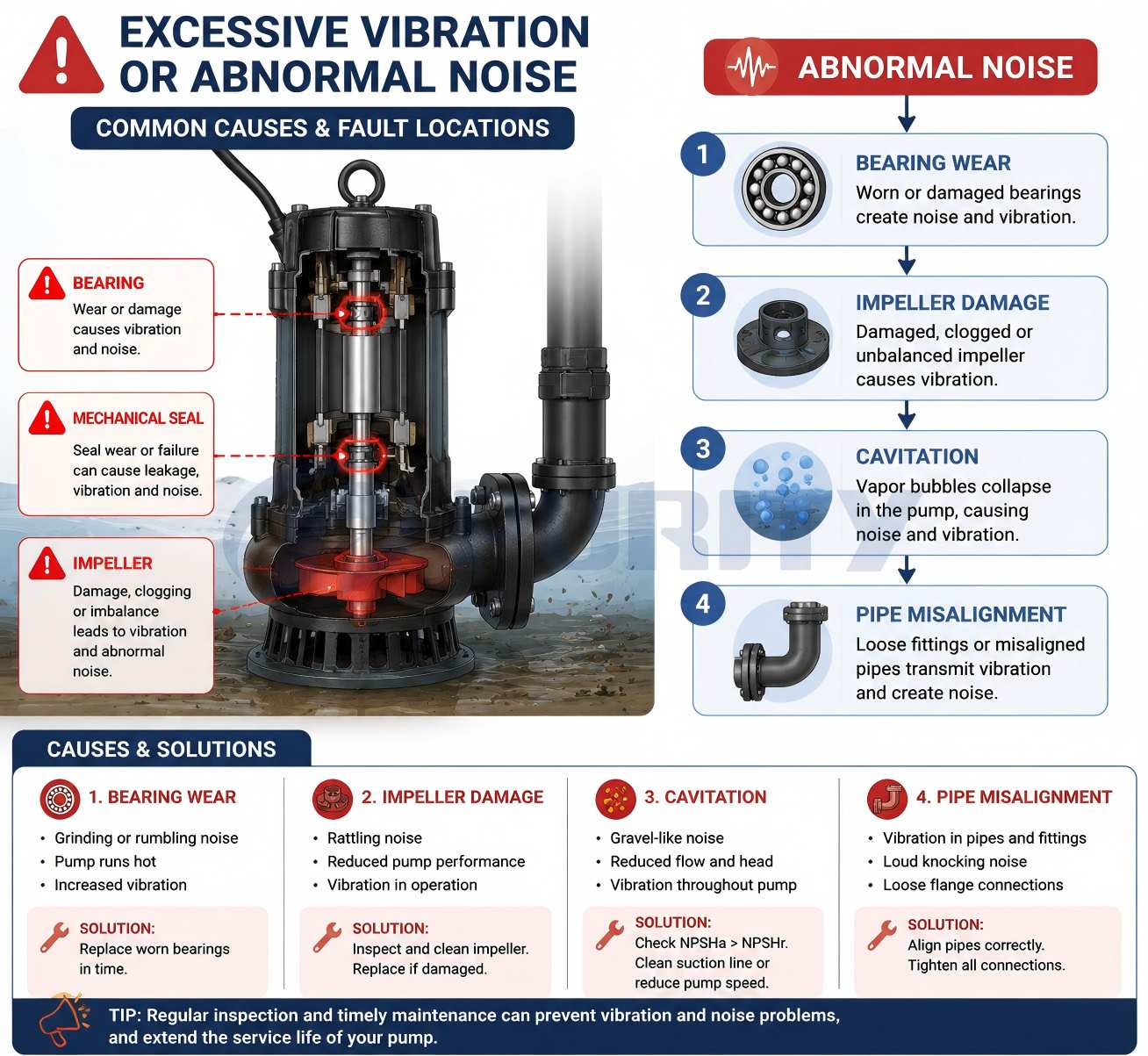
4. Excessive Vibration or Abnormal Noise
Picture |Excessive Vibration or Abnormal Noise
Symptoms: Loud rattling, grinding, or vibration felt through the discharge piping.
Common Causes & Fixes:
| Cause | Solution |
| Worn or damaged bearings | Remove the pump and replace bearings — operating with failed bearings will destroy the mechanical seal next |
| Damaged impeller (chipped or unbalanced) | Inspect the impeller; replace if vanes are broken or pitted |
| Cavitation — vapor bubbles collapsing in the pump | Check that NPSHa exceeds NPSHr; clean the suction line; reduce pump speed if using a VFD |
| Loose mounting or misaligned discharge piping | Tighten all bolts; realign rigid piping connections |
Prevention: Quarterly vibration monitoring with a handheld meter can detect bearing wear months before audible symptoms appear.
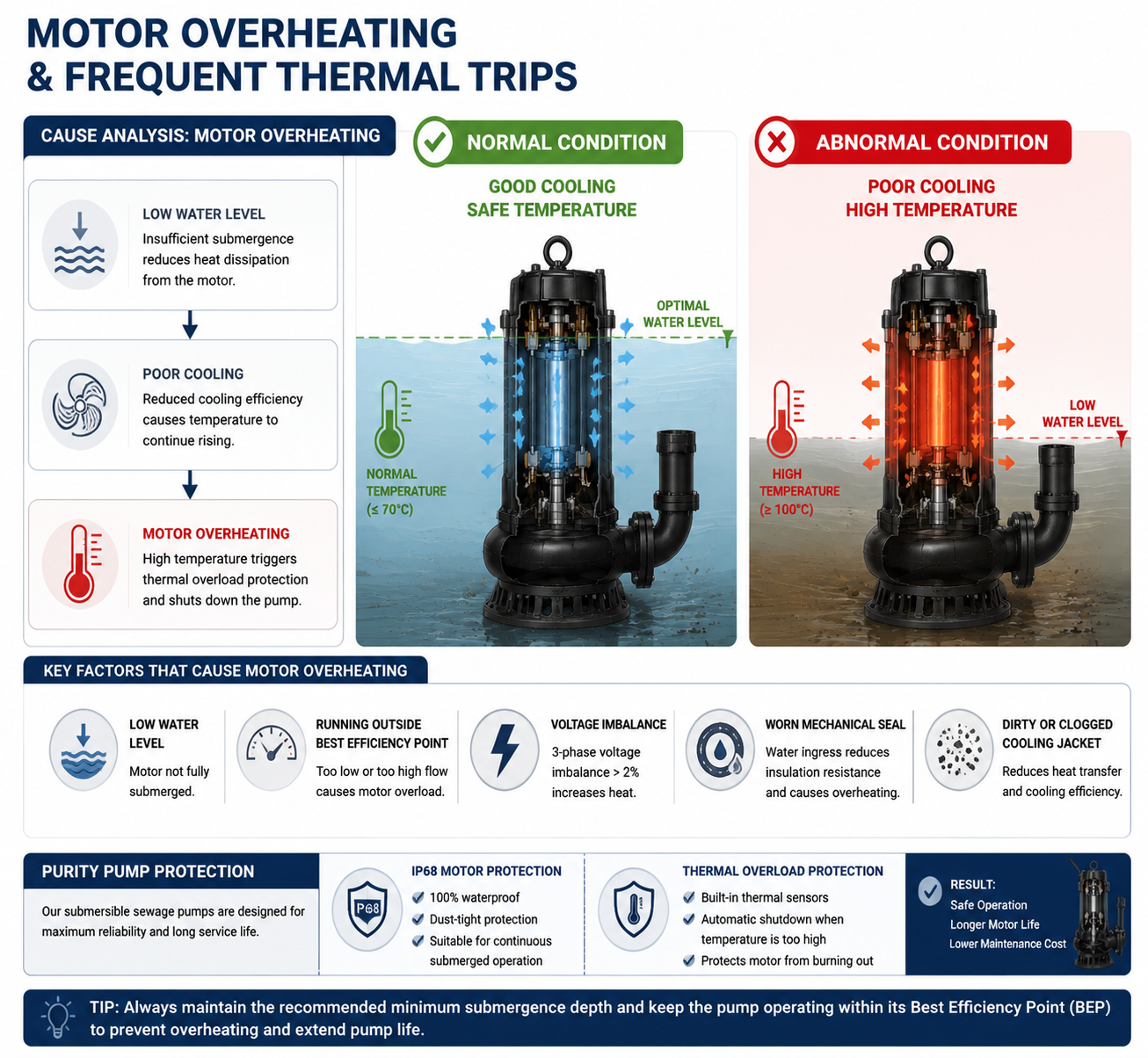
5. Motor Overheating and Frequent Thermal Trips
Picture |Motor Overheating & Frequent Thermal Trips
Symptoms: The pump’s thermal protector trips repeatedly, especially during hot weather or extended run cycles.
| Cause | Solution |
| Pump running at very low or very high flow — outside the recommended operating range | Verify the pump is operating near its Best Efficiency Point (BEP); trim the impeller or adjust system valves |
| Inadequate cooling due to low water level | Ensure the minimum submergence depth is maintained at all times — the motor relies on surrounding fluid for cooling |
| Voltage imbalance (3-phase motors) | Measure voltage across all three phases; imbalance should not exceed 2% |
| Worn mechanical seal allowing moisture into the motor housing | Test motor insulation resistance with a megohmmeter; if below 1 MΩ, replace seals and dry the motor windings |
6. Preventive Maintenance Schedule
A disciplined maintenance routine prevents most failures entirely. Below is a recommended schedule for industrial sewage pumps:
| Interval | Task |
| Weekly | Listen for unusual noise or vibration; check control panel for alarms |
| Monthly | Inspect suction screen; test check valve; verify pump starts and stops correctly |
| Quarterly | Measure motor insulation resistance; check mechanical seal for leakage; inspect impeller for wear |
| Annually | Replace mechanical seals; change bearing lubricant or replace sealed bearings; full performance test against original pump curve |
| Every 3 Years | Complete overhaul — replace bearings, seals, wear rings, and any corroded fasteners |
Reliable Sewage Pumps, Backed by Expert Support
At Purity Pump , our WQV series submersible sewage pumps are engineered to minimize the very problems described above — with robust vortex and channel impeller options, oversized bearings for extended service life, and high-quality mechanical seals that keep wastewater where it belongs. Serving over 130 countries, we provide not just pumps, but complete lifecycle support.
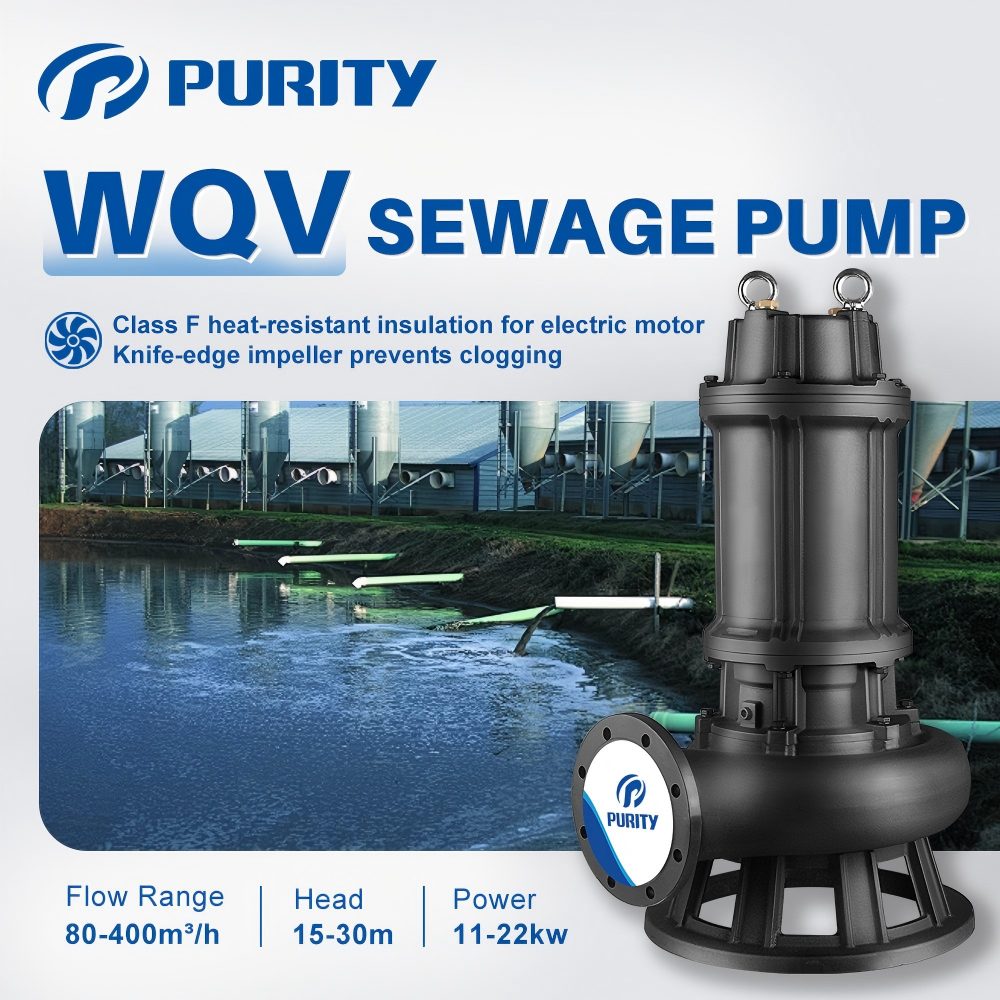
Picture |Submersible Sewage Pump WQV
Contact Purity Pump for troubleshooting support, spare parts, or a preventive maintenance plan tailored to your facility.
Post time: Jul-29-2026


