
When selecting a centrifugal pump for an industrial, commercial, HVAC, or water supply system, two commonly considered options are the inline pump and the end suction pump. Although both are centrifugal pump designs used to move fluids, their construction, installation requirements, space requirements, and typical applications are different.
So, which pump is right for your system?
The answer depends on several factors, including required flow rate, head, available installation space, piping configuration, maintenance requirements, and operating conditions.
What Is an End Suction Pump?
An end suction pump is a centrifugal pump in which fluid enters through the end of the pump casing and is discharged through an outlet, typically located at the top of the casing. Most end suction pumps use a horizontal configuration and are installed on a base or foundation.
An end suction centrifugal pump is widely used because of its relatively simple construction, broad performance range, and convenient maintenance access.
Typical applications include:
- · Industrial water transfer
- · Municipal water supply
- · Agricultural irrigation
- · Cooling water systems
- · General industrial processes
- · Commercial water systems
For applications requiring higher flow capacity, flexible installation, and easy access for maintenance, an end suction pump is often a practical choice.
What Is an Inline Pump?
An inline pump, also known as an inline centrifugal pump, is designed with suction and discharge connections located on the same centerline. This allows the pump to be installed directly within the piping system.
Many inline pumps use a vertical configuration, which significantly reduces their floor-space requirements.
Inline pumps are commonly found in:
- · HVAC systems
- · Chilled water systems
- · Hydronic heating and cooling
- · Commercial buildings
- · Closed-loop circulation systems
- · Booster applications
The main advantage of an inline pump is its compact installation. It can simplify piping layouts and make better use of limited mechanical-room space.
Inline Pump vs. End Suction Pump: Key Differences
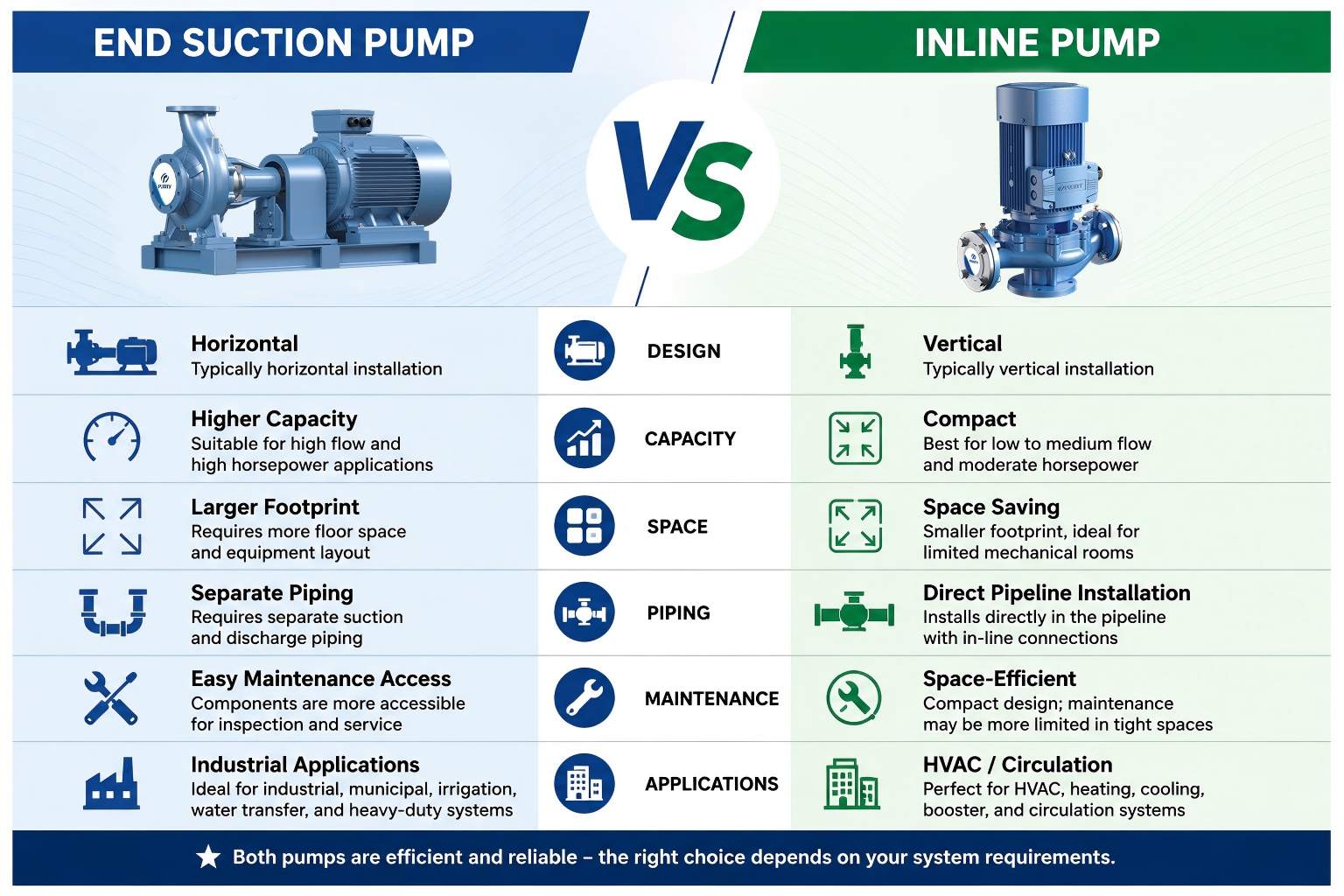 Picture|End Suction Pump VS Inline Pump
The most important differences between an inline pump and an end suction pump can be summarized across several areas.
1. Pump Design and Installation
An end suction pump generally uses a horizontal layout and requires a pump base, separate suction and discharge piping, and sufficient space for installation and maintenance.
An inline pump is installed directly into the pipeline, with the suction and discharge connections aligned along the same axis. This can simplify the piping arrangement and reduce the pump’s footprint.
2. Space Requirements
Space is one of the biggest factors when comparing these two pump types.
An end suction pump normally requires more floor space because the pump, motor, coupling, base, and service area must be accommodated.
An inline centrifugal pump has a much smaller footprint and is particularly useful in compact mechanical rooms or installations where floor space is limited.
3. Flow and Capacity
End suction pumps are commonly selected for medium- to high-flow applications and are available in a wide range of sizes and configurations.
Inline pumps are frequently used for small- to medium-flow circulation applications, particularly in HVAC and hydronic systems.
However, pump type alone should not determine capacity. The actual selection should always be based on the required flow rate, head, system curve, and operating point.
4. Maintenance and Accessibility
End suction pumps generally provide convenient access to major components, making inspection, repair, and routine maintenance relatively straightforward.
Inline pumps offer a more compact installation, but maintenance access can depend heavily on the surrounding piping and mechanical-room layout. In confined spaces, accessing internal components may require additional disassembly.
Therefore, maintenance accessibility should be considered during the initial pump selection rather than after installation.
5. Typical Applications
The application is another important distinction.
An end suction centrifugal pump is often preferred for industrial water transfer, irrigation, municipal systems, cooling applications, and other systems where capacity, flexibility, and maintenance access are important.
An inline pump is particularly suitable for HVAC circulation, chilled water loops, hydronic systems, and commercial buildings where compact installation and simplified piping are priorities.
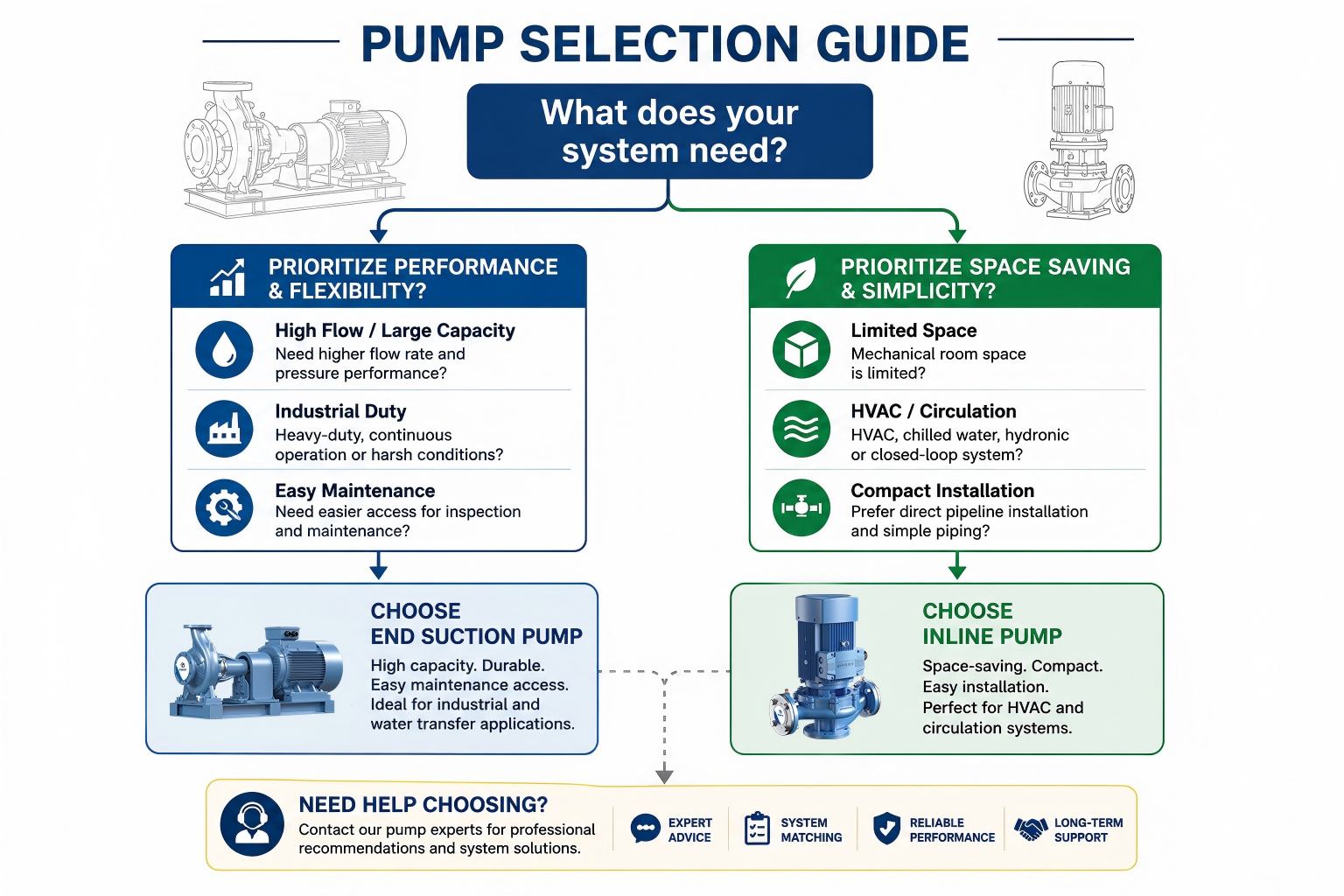
Which Pump Should You Choose?
 Picture|Centrifugal Pump Selection
There is no universal answer to whether an inline pump or end suction pump is better.
Choose an end suction pump when your system prioritizes:
- · Higher flow capacity
- · Industrial-duty operation
- · Flexible system configurations
- · Easy maintenance access
- · Larger water transfer applications
Choose an inline pump when your system prioritizes:
- · Limited installation space
- · Compact equipment layouts
- · Simplified piping
- · HVAC or hydronic circulation
- · Closed-loop water systems
In simple terms:
End Suction = Capacity + Flexibility + Maintenance Accessibility
Inline = Compactness + Space Efficiency + Simplified Piping
Pump Efficiency: Correct Selection Matters
Pump efficiency is not determined simply by choosing an inline or end suction design.
A properly selected pump should operate close to its appropriate operating range and match the actual system requirements. An oversized centrifugal pump can produce excessive flow or pressure, forcing operators to throttle the system and waste energy.
Other factors affecting energy consumption include motor efficiency, variable frequency drive (VFD) control, system resistance, operating hours, and pump sizing.
Therefore, the most efficient pump is not necessarily the most powerful pump. It is the pump correctly matched to the system.
Choosing the Right Centrifugal Pump Supplier
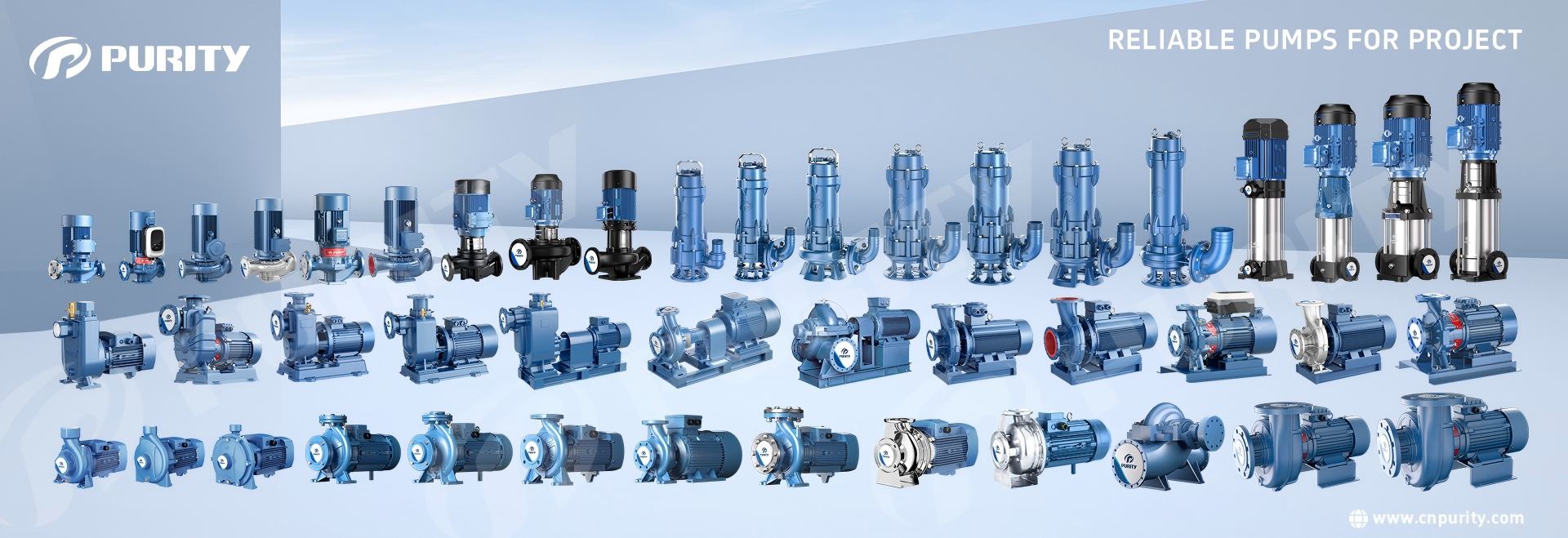 Picture|Purity Full Product Range
For projects requiring different flow rates, heads, materials, and installation configurations, working with experienced centrifugal pump suppliers can simplify pump selection.
A capable supplier should offer a broad product portfolio, accurate technical parameters, reliable quality control, relevant certifications, and technical support.
Purity Pump, for example, offers multiple centrifugal pump solutions, including end suction pumps, inline pumps, multistage pumps, horizontal centrifugal pumps, and split-case pumps. With 16+ years of manufacturing and sales experience, a wide range of pump specifications, and 130+ certifications including CE, ISO, and SASO, Purity can provide different pump solutions for various water and industrial applications.
The advantage of working with a supplier with multiple pump types is that customers do not have to select a pump based only on the products available from one category. Instead, the pump can be matched more closely to the actual system requirements.
Conclusion
The key difference between an inline pump and an end suction pump is not simply their appearance. Their installation configuration, space requirements, capacity, maintenance accessibility, and typical applications are different.
An end suction centrifugal pump is generally a strong choice when higher capacity, flexibility, durability, and maintenance accessibility are important. An inline centrifugal pump is often better suited to compact installations, HVAC systems, and closed-loop circulation where space efficiency and simplified piping are priorities.
Ultimately, the right choice should be based on flow, head, system configuration, available space, maintenance requirements, efficiency, and total operating cost.
Instead of asking, “Which pump is better?”, the more useful question is:
“Which pump is better for my system?”
Post time: Aug-19-2026

