
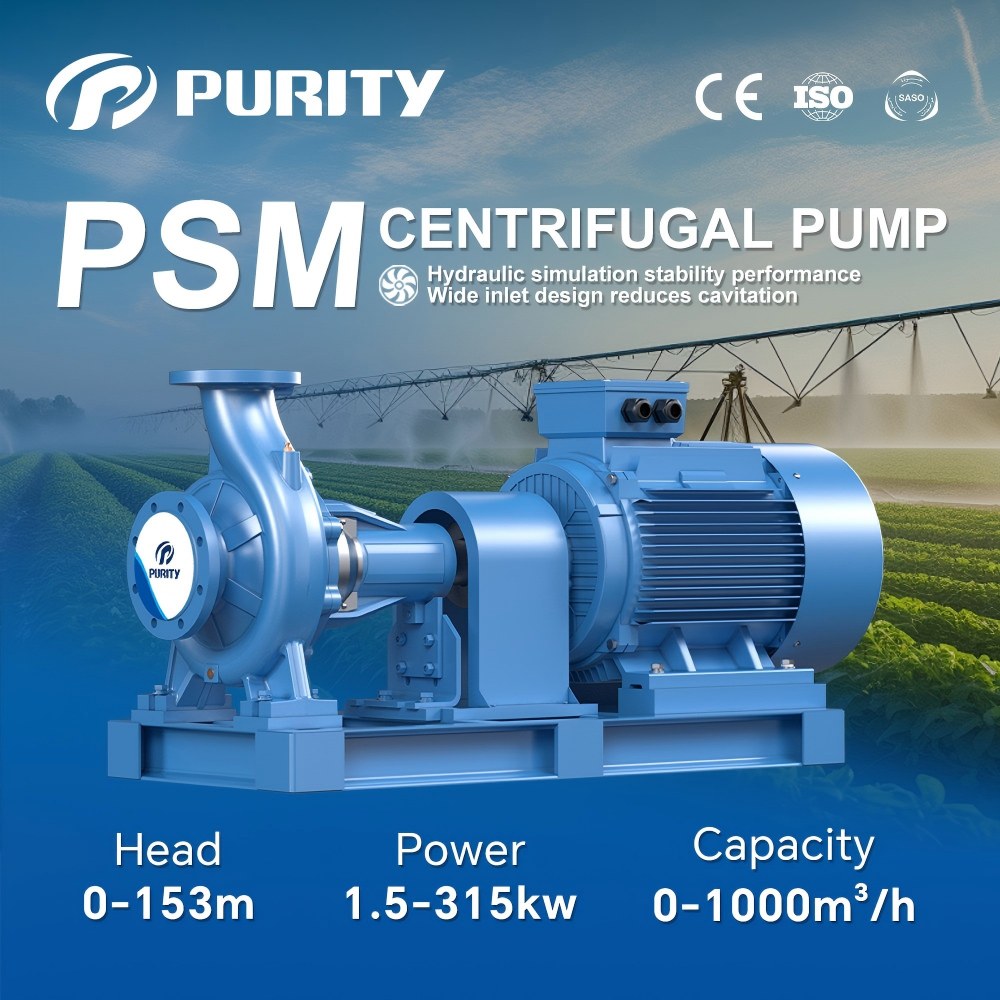
Picture|Purity Centrifugal Pump PSM
A pump’s reliability is decided long before it ever runs — at the moment of installation. Industry studies show that up to 80% of premature pump failures trace back to incorrect installation or poor piping design, not manufacturing defects. A well-built pump can fail in weeks if its suction line is misrouted or its foundation is misaligned. This guide covers the critical rules of centrifugal pump installation and piping, so your system runs efficiently for decades instead of months.
1. Foundation and Alignment: The Starting Point
The pump must be mounted on a rigid, level concrete foundation with properly tensioned anchor bolts. Before finalizing the coupling, verify shaft alignment — the recommended tolerance is within 0.05 mm (0.002 inches) for flexible couplings. Most importantly, never use the piping to pull the pump into position. Pipe stress transmitted to the pump casing causes misalignment, bearing wear, and seal failure. Connect the pipes only after the pump is aligned and grouted.
2. Suction Piping: Where Most Problems Begin
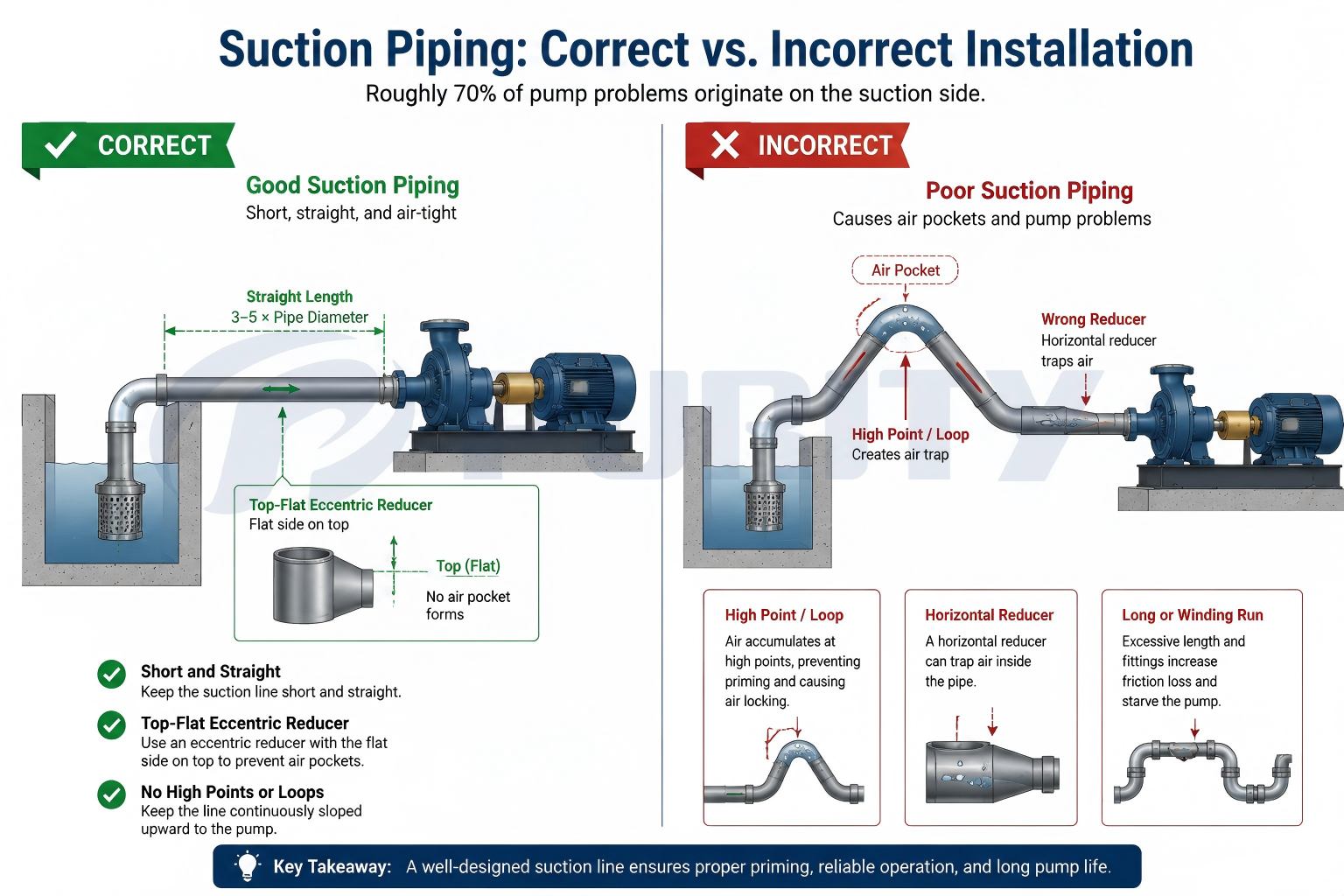
Picture|Comparison diagram of centrifugal pump suction piping
Roughly 70% of pump problems originate on the suction side. Three rules matter most:
Keep the suction line short and straight. The suction pipe should be at least 3–5 times the pipe diameter in straight length before the pump inlet. Longer, winding runs increase friction loss and starve the pump.
Use a top-flat eccentric reducer. When pipe diameter reduces toward the pump inlet, the reducer must be eccentric — installed with the flat side on top — so no air pocket forms inside the pipe.
Avoid loops and high points. Any elevation above the pump inlet creates an air trap that prevents proper priming and leads to air locking.
3. Discharge Piping: Protection and Support
The discharge line should include, in this order: a check valve (to prevent backflow), a gate valve (for maintenance isolation), and a pressure gauge. Support the discharge pipe with independent hangers or stands — the pump casing must not carry the pipe’s weight. For long discharge runs, install expansion joints to absorb thermal growth and prevent stress on the pump flanges.
4. Electrical Connections and Protection
For three-phase motors, verify rotation direction before coupling the pump — a dry-run of a few seconds in the wrong direction is acceptable, but never let a miswired motor run coupled. Fit the motor with thermal overload protection sized to the motor nameplate rating. If the system uses a VFD, confirm the motor is inverter-rated to handle the voltage spikes from variable-speed operation.
5. Commissioning Checklist: Before First Start
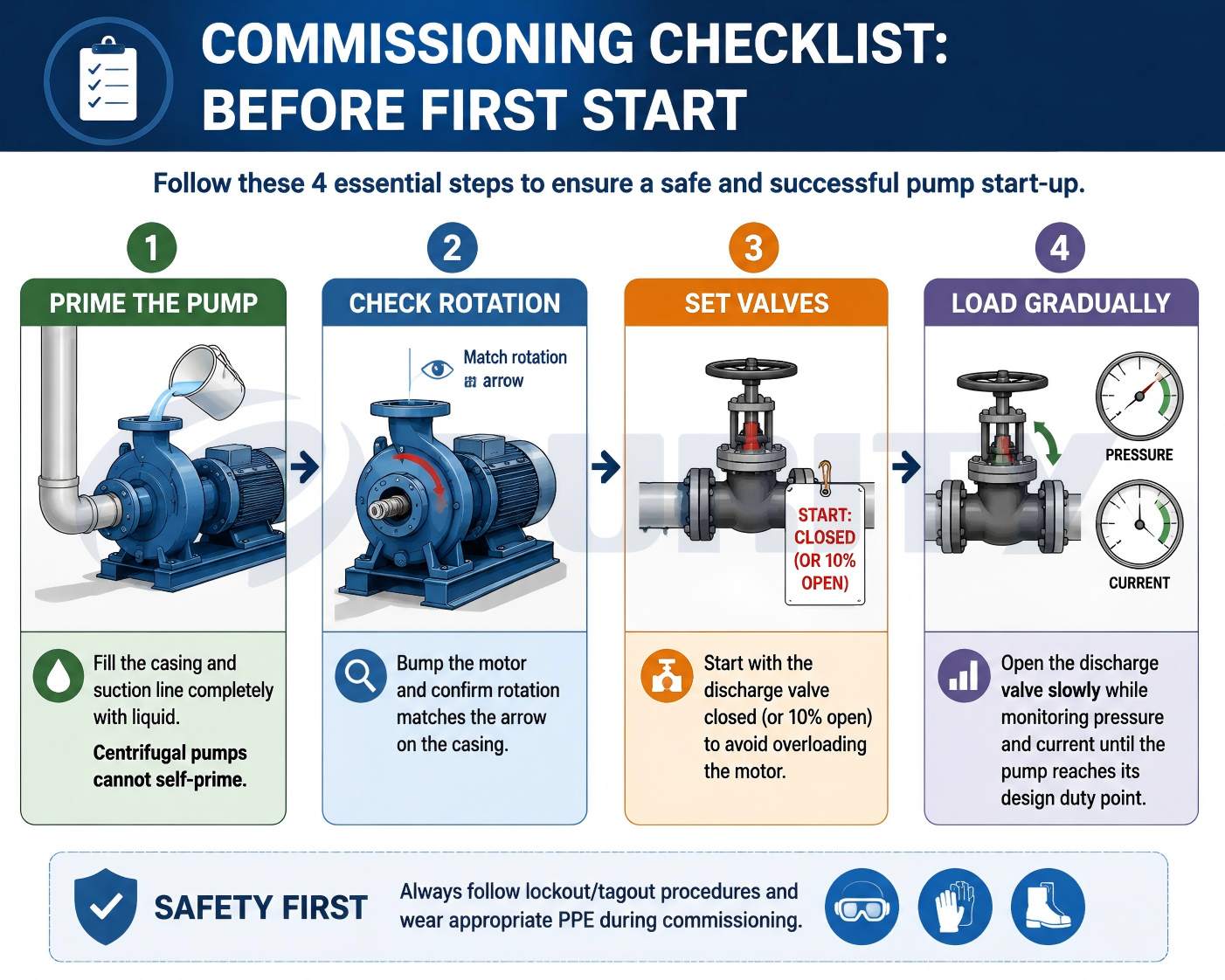 Picture|Checklist/Diagram of Centrifugal Pump Commissioning Steps
Prime the pump: fill the casing and suction line completely with liquid — centrifugal pumps cannot self-prime.
Check rotation: bump the motor and confirm rotation matches the arrow on the casing.
Set valves: start with the discharge valve closed (or 10% open) to avoid overloading the motor.
Load gradually: open the discharge valve slowly while monitoring pressure and current until the pump reaches its design duty point.
6. Frequently Asked Questions
Q: Can a centrifugal pump be installed above the liquid level?
Yes — this is a suction-lift configuration. But the total suction lift is physically limited to about 8 meters at sea level (roughly 10.3 m theoretical maximum minus friction and vapor pressure losses), and every meter of lift reduces NPSH available. For reliability, flooded suction is always preferred.
Q: Why use an eccentric reducer instead of a concentric one on suction piping?
A concentric reducer installed horizontally creates a high point where air accumulates. The trapped air pocket causes unstable flow and can air-lock the pump. An eccentric reducer with the flat side up eliminates this air pocket entirely.
Q: What happens if the discharge valve is left closed when the pump starts?
With the discharge valve fully closed, the pump operates at shut-off head, recirculating fluid inside the casing. If left in this state, the liquid overheats, vaporizes, and can cause severe seal and impeller damage within minutes.
Installation-Support from Purity Pump
At Purity Pump , our engineering team supports customers across 130+ countries with installation guidance, technical drawings, and commissioning assistance — ensuring your centrifugal pump is installed right the first time. ISO-certified manufacturing and rigorous shop testing guarantee the pump you receive performs exactly as specified.
Contact Purity Pump for installation manuals, piping layout drawings, or expert technical support for your next project.
Post time: Aug-06-2026


