
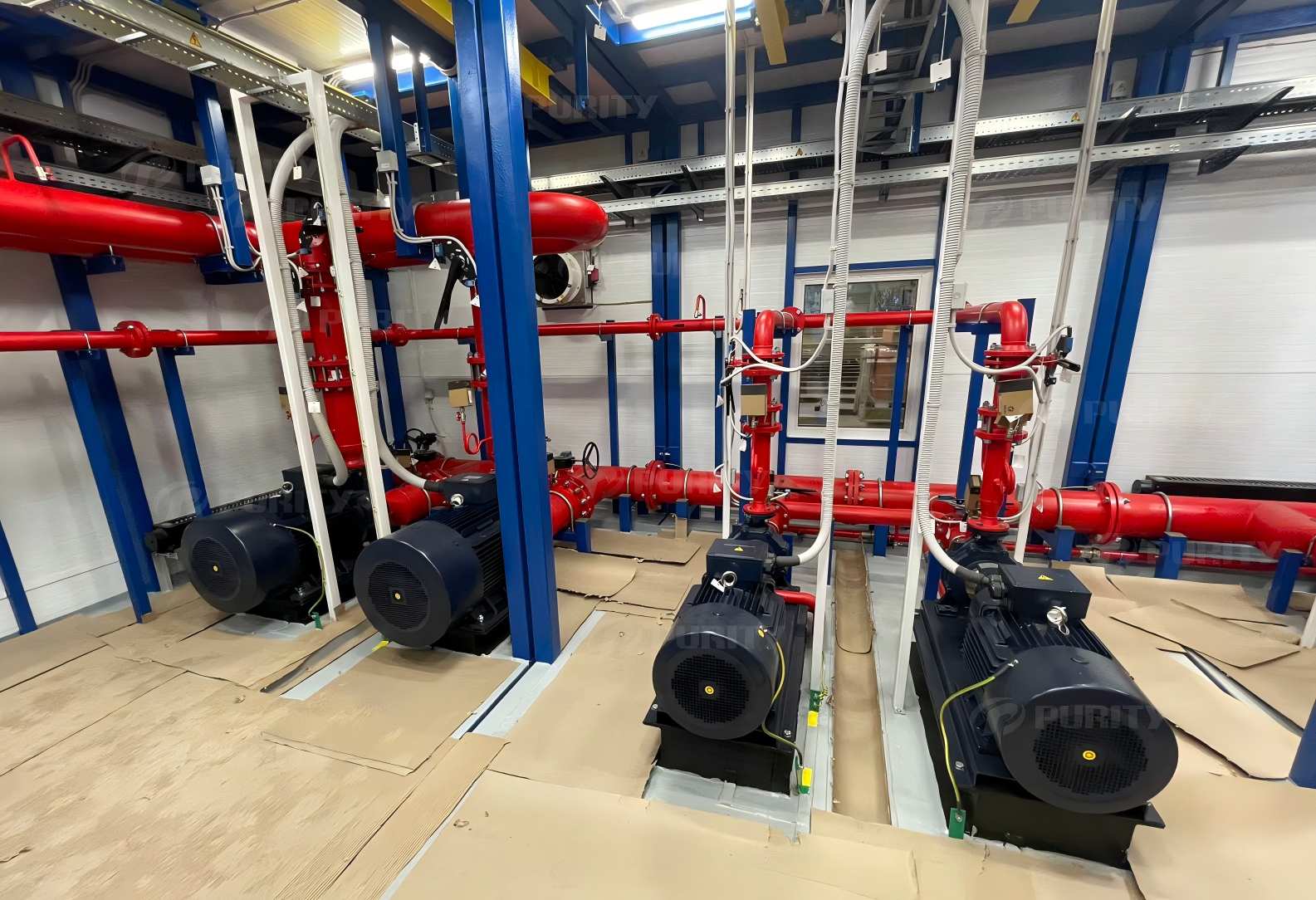
Picture | On-site photo of the Purity PSM End-suction Centrifugal Pump
An end suction pump is one of the most widely used centrifugal pumps for transferring clean water and other low-viscosity liquids. With a simple structure, reliable operation, easy maintenance, and relatively low lifecycle cost, it is commonly used in water supply, HVAC, irrigation, industrial processing, firefighting, and water treatment systems.
But what exactly is an end suction pump, how does it work, and how do you choose the right model? This guide explains its working principle, types, advantages, limitations, applications, and key selection factors.
What Is an End Suction Pump?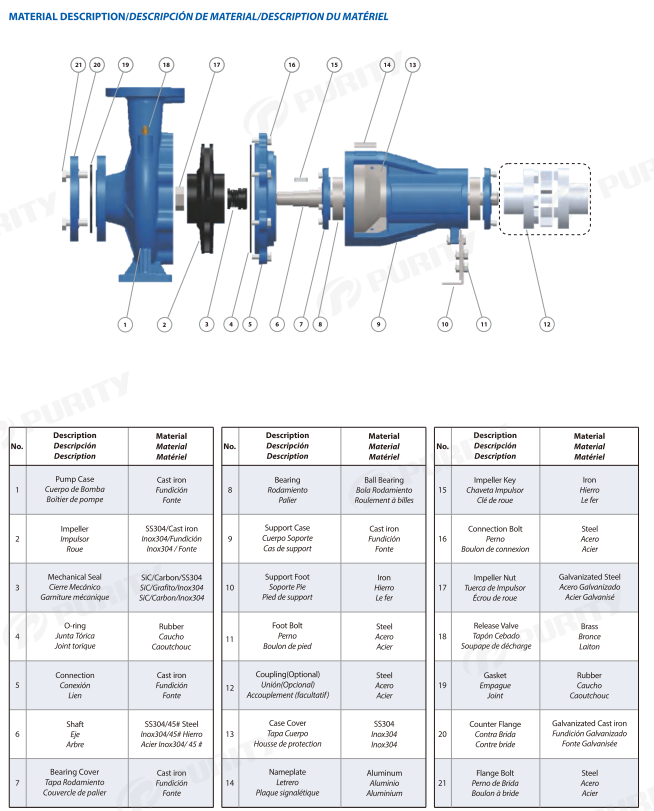 Picture | Purity PSM series end-suction centrifugal pump assembly
An end suction centrifugal pump is a centrifugal pump in which liquid enters axially through a suction nozzle located at one end of the pump casing and exits radially through the discharge outlet.
Most end suction pumps use a single impeller, making them particularly suitable for low- to medium-head applications. Their relatively compact construction also makes them easy to install and maintain.
A typical end suction pump consists of:
- · Pump casing or volute
- · Impeller
- · Shaft and bearings
- · Mechanical seal or gland packing
- · Coupling and baseplate
The term “end suction” describes the position of the suction inlet rather than a specific material or drive configuration. Depending on the application, end suction pumps can be supplied in cast iron, stainless steel, or other special materials.
How Does an End Suction Centrifugal Pump Work?
An end suction centrifugal pump works by converting mechanical energy from a motor or engine into hydraulic energy.
The process can be summarized in four steps:
Liquid enters → Impeller accelerates the liquid → Velocity converts to pressure → Pressurized liquid is discharged
First, liquid enters the impeller eye through the suction port. As the impeller rotates, centrifugal force accelerates the liquid toward the outer edge of the impeller. The volute casing then slows the liquid and converts part of its velocity energy into pressure energy. Finally, the pressurized liquid leaves through the discharge outlet and enters the piping system.
Because the suction side and discharge side have different pressure conditions, proper suction piping and NPSH conditions are important. If the available NPSH is insufficient, cavitation may occur, causing noise, vibration, reduced performance, and potential impeller damage.
What Types of End Suction Pumps Are Available?
End suction pumps can be configured in several ways according to installation, coupling, material, and industry requirements.
Horizontal End-Suction Centrifugal Pump
The horizontal end-suction centrifugal pump is one of the most common configurations. The pump and motor are installed horizontally and may use either a close-coupled or frame-mounted design.
It is widely used for:
- · Water supply
- · HVAC circulation
- · Irrigation
- · Industrial processes
- · General water transfer
Close-Coupled End Suction Pump
In a close-coupled design, the pump is directly connected to the motor. This reduces the overall footprint and simplifies installation, making it suitable for compact systems.
Frame-Mounted End Suction Pump
A frame-mounted pump uses a coupling between the pump and motor and is installed on a common baseplate. This configuration is suitable for demanding industrial applications and can simplify maintenance, especially when a back pull-out design allows the rotating assembly to be removed without disconnecting the main piping.
Stainless Steel End Suction Pump
When the pumped liquid is corrosive or requires greater material resistance, stainless steel construction may be selected. For example, SS304 or SS316 may be considered for certain water treatment, food processing, chemical, or seawater applications, depending on the actual fluid conditions.
What Are the Advantages of End Suction Pumps?
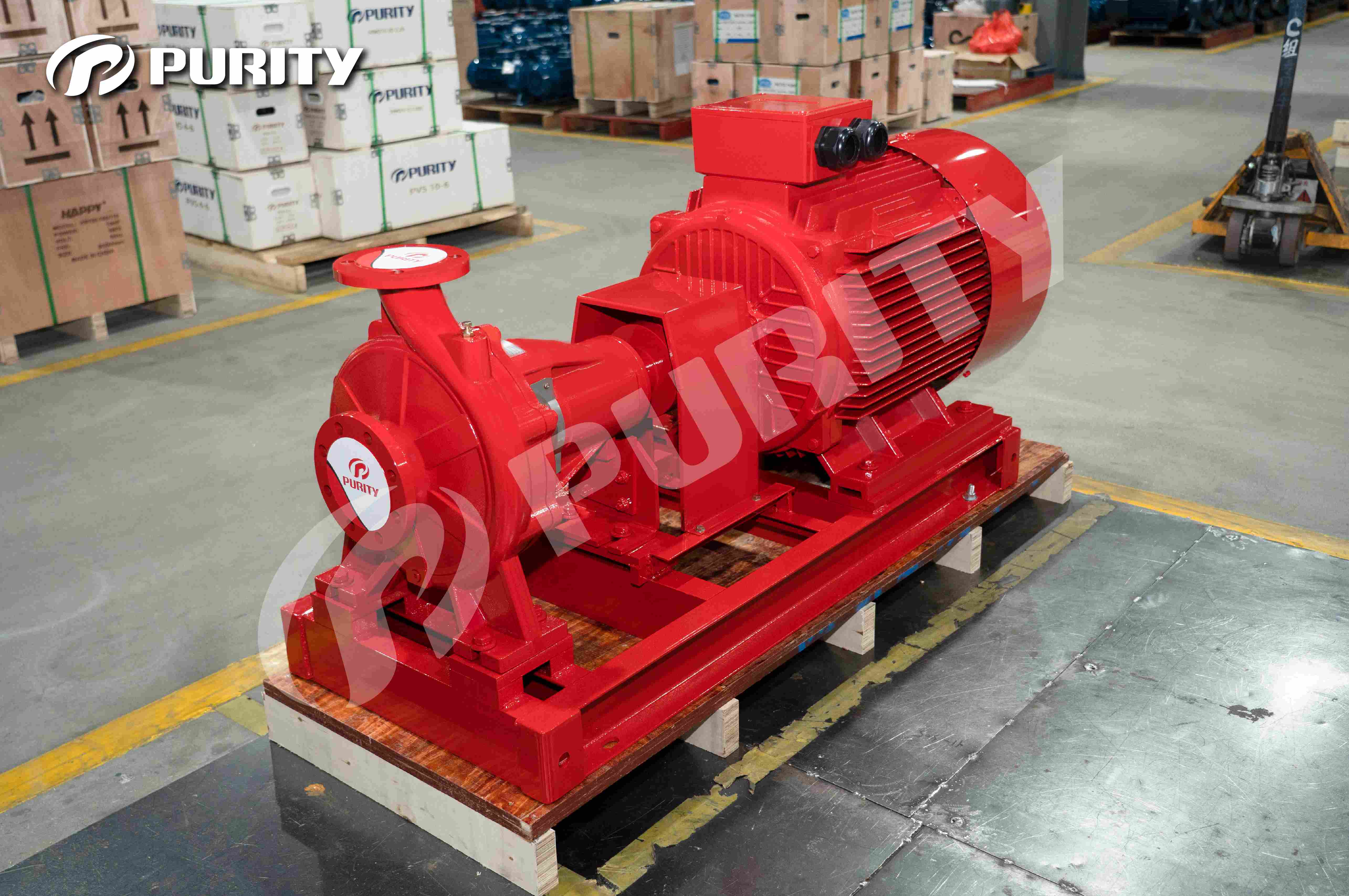
Picture | Purity PSM End-Suction Centrifugal Pump
The popularity of end suction pumps comes from their balance of performance, cost, and maintainability.
Simple and reliable: Their mature centrifugal design makes operation and troubleshooting relatively straightforward.
Cost-effective: They generally have lower installation and maintenance costs than more complex pump configurations.
Easy to maintain: Common components such as seals, bearings, and impellers are accessible for inspection and replacement.
Compact: Close-coupled versions are particularly useful where installation space is limited.
Versatile: Different flow rates, heads, materials, seals, and motor configurations allow end suction pumps to serve many applications.
However, these advantages do not mean that an end suction pump is suitable for every application.
What Are the Limitations of an End Suction Pump?
Most end suction pumps are single-stage pumps, so they are generally better suited to moderate-head applications. When a system requires very high pressure or head, a multistage centrifugal pump may be a better solution.
They may also be less suitable for:
- · High-viscosity liquids
- · Heavy abrasive slurries
- · Large amounts of solids
- · Highly corrosive liquids without appropriate materials
- · Applications with poor suction conditions
For any centrifugal pump, NPSH should also be checked carefully. The basic requirement is that NPSHa should exceed NPSHr to reduce the risk of cavitation.
How Do You Select an End Suction Centrifugal Water Pump?
Choosing an end suction centrifugal water pump should begin with the actual system requirements rather than simply selecting a pump based on pipe size.
1. Determine Flow Rate
Calculate the required flow rate based on the water demand or process requirement.
2. Calculate Total Head
Total dynamic head should consider:
- · Static head
- · Pipe friction losses
- · Valve and fitting losses
- · Required discharge pressure
3. Check NPSH
Make sure the available NPSH is sufficient for the selected pump, especially for high-flow applications.
4. Consider the Fluid
Evaluate temperature, viscosity, pH, corrosiveness, abrasiveness, and solids content before selecting the pump.
5. Select Materials and Seals
Clean water applications may use cast iron components, while corrosive or special fluids may require stainless steel or other alloys. Mechanical seals or gland packing should also be selected according to the operating conditions.
6. Choose the Installation Configuration
Close-coupled pumps are suitable for compact installations, while frame-mounted designs can be advantageous for continuous industrial operation and easier maintenance.
Where Are End Suction Pumps Used?
Because of their versatility, end suction pumps are found in many industries.
Water supply: Building water supply, municipal water transfer, and booster systems.
HVAC: Chilled-water circulation, cooling towers, and hot-water circulation.
Industrial processes: Cooling water, process water, and general fluid transfer.
Irrigation: Agricultural irrigation, sprinkler systems, and water lifting.
Fire protection: Certain fire-water and auxiliary pumping applications, depending on project requirements and applicable standards.
Water treatment: Filtration, clean-water transfer, and other treatment processes.
Marine applications: Seawater cooling and utility water systems when suitable corrosion-resistant materials are used.
An Example of End Suction Pump Design
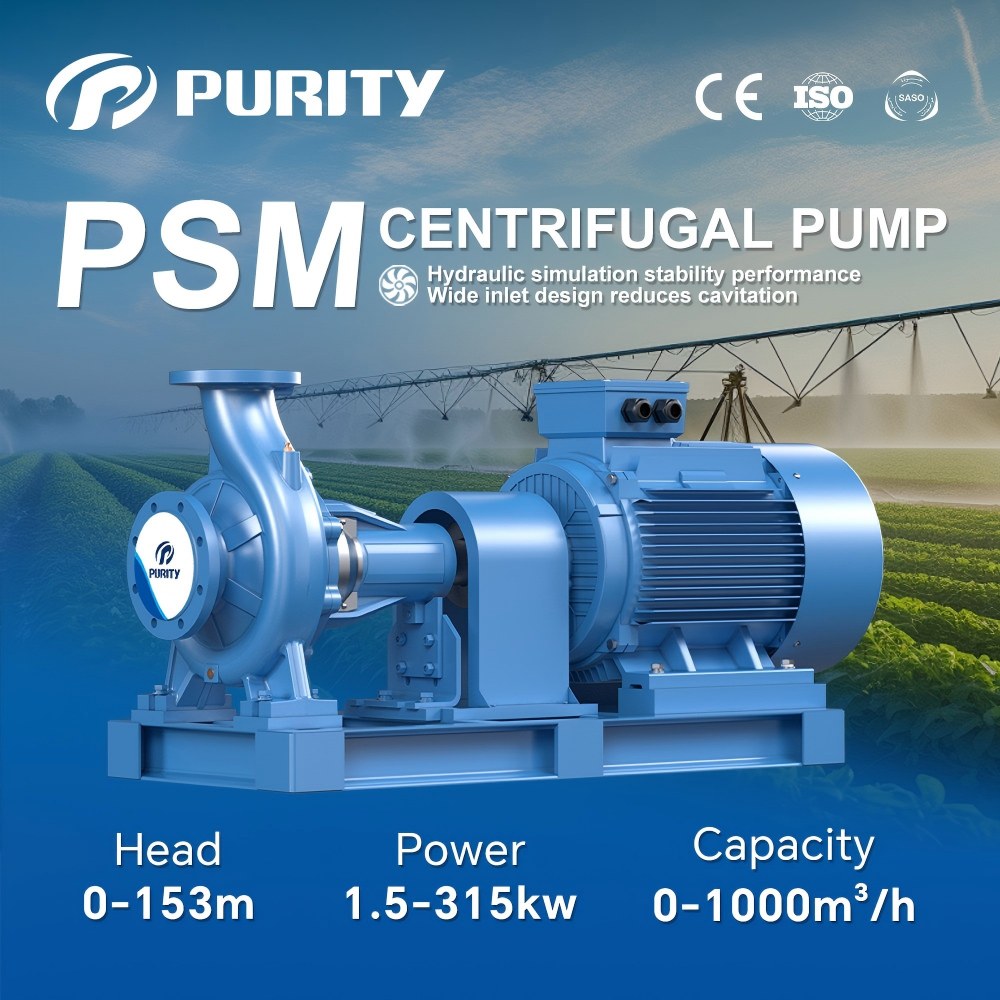 Picture | Purity PSM End-Suction Centrifugal Pump
The performance of an end suction pump depends heavily on its hydraulic design and configuration. For example, Purity’s PSM series end suction centrifugal pump uses a hydraulic design with an inlet diameter larger than the outlet diameter, helping provide sufficient water intake and support stable operation.
Its hydraulic design is optimized through simulation to achieve a smooth performance curve and high hydraulic efficiency. Combined with standard electric motors and a range of pump sizes, the PSM series can be configured for different flow and power requirements.
This illustrates an important point when selecting an end suction pump: the pump’s structure and hydraulic design should match the actual operating point rather than relying on the pump type alone.
For an experienced pump manufacturer, product selection is also about maintaining consistent quality across different configurations. Purity Pump has more than 16 years of pump manufacturing and sales experience and operates a 60,000 m² production facility with an annual production capacity of more than 150,000 pumps. Its product range covers centrifugal, fire, sewage, multistage, and other industrial pump solutions.
How to Maintain an End Suction Pump
Proper maintenance can help maintain efficiency and extend service life.
- · Keep the suction pipeline clean and free of air leaks.
- · Avoid dry running.
- · Check pump and motor alignment.
- · Inspect mechanical seals and bearings regularly.
- · Monitor vibration and abnormal noise.
- · Keep the motor properly ventilated.
- · Follow recommended lubrication intervals.
- · Avoid unnecessary frequent starts and stops.
Correct selection, installation, and maintenance work together to improve long-term pump reliability.
Conclusion
So, what is an end suction pump? It is a simple and versatile centrifugal pump designed primarily for transferring clean water and other low-viscosity liquids at low to moderate heads.
Its combination of reliability, compact design, cost-effectiveness, and easy maintenance explains why end suction pumps remain widely used in water supply, HVAC, irrigation, industrial processing, firefighting, and water treatment.
However, choosing the right pump requires more than identifying the pump type. Flow rate, total head, NPSH, fluid characteristics, materials, sealing, motor power, and installation configuration should all be evaluated.
When these factors are properly matched, an end suction centrifugal pump can provide stable, efficient, and reliable fluid transfer for many years.
Post time: Aug-12-2026


