
Most facility managers focus on a pump’s purchase price. But here is a startling fact: for an industrial centrifugal pump running 24/7, the purchase cost represents only 5–10% of its total lifecycle cost. The remaining 85–90% is electricity consumed over its 15–20 year service life. A pump that is just 10% more efficient can save more than its entire purchase price — every single year.
This guide explains four proven strategies to cut your centrifugal pump’s energy consumption, extend equipment life, and reduce your carbon footprint.
1. The Best Efficiency Point (BEP): Your Pump’s Sweet Spot
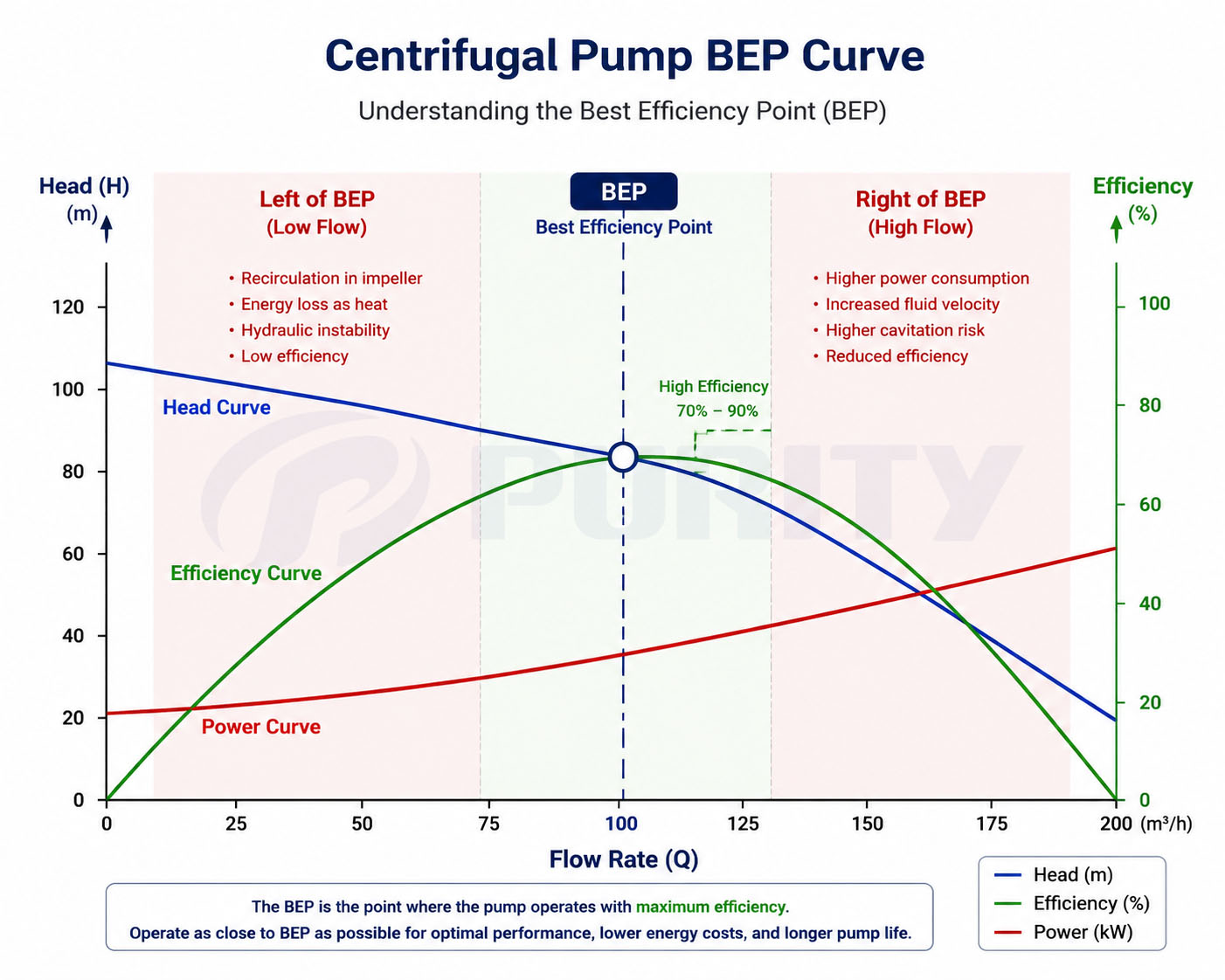 Picture|Centrifugal Pump BEP Curve
Every centrifugal pump has a Best Efficiency Point (BEP) — the specific combination of flow rate and head where it converts electrical power into hydraulic energy at peak efficiency, typically 70–90% for modern designs.
Operating far from BEP triggers two problems:
(1)Left of BEP (low flow): Fluid recirculates inside the impeller, wasting energy as heat and causing hydraulic instability.
(2)Right of BEP (high flow): The motor draws excessive current, fluid velocity spikes, and cavitation risk rises sharply.
The golden rule: select a pump whose BEP aligns with your system’s normal operating point. Even a 5% deviation can waste thousands of dollars in electricity per year.
2. Variable Frequency Drives (VFD): Smart Speed Control
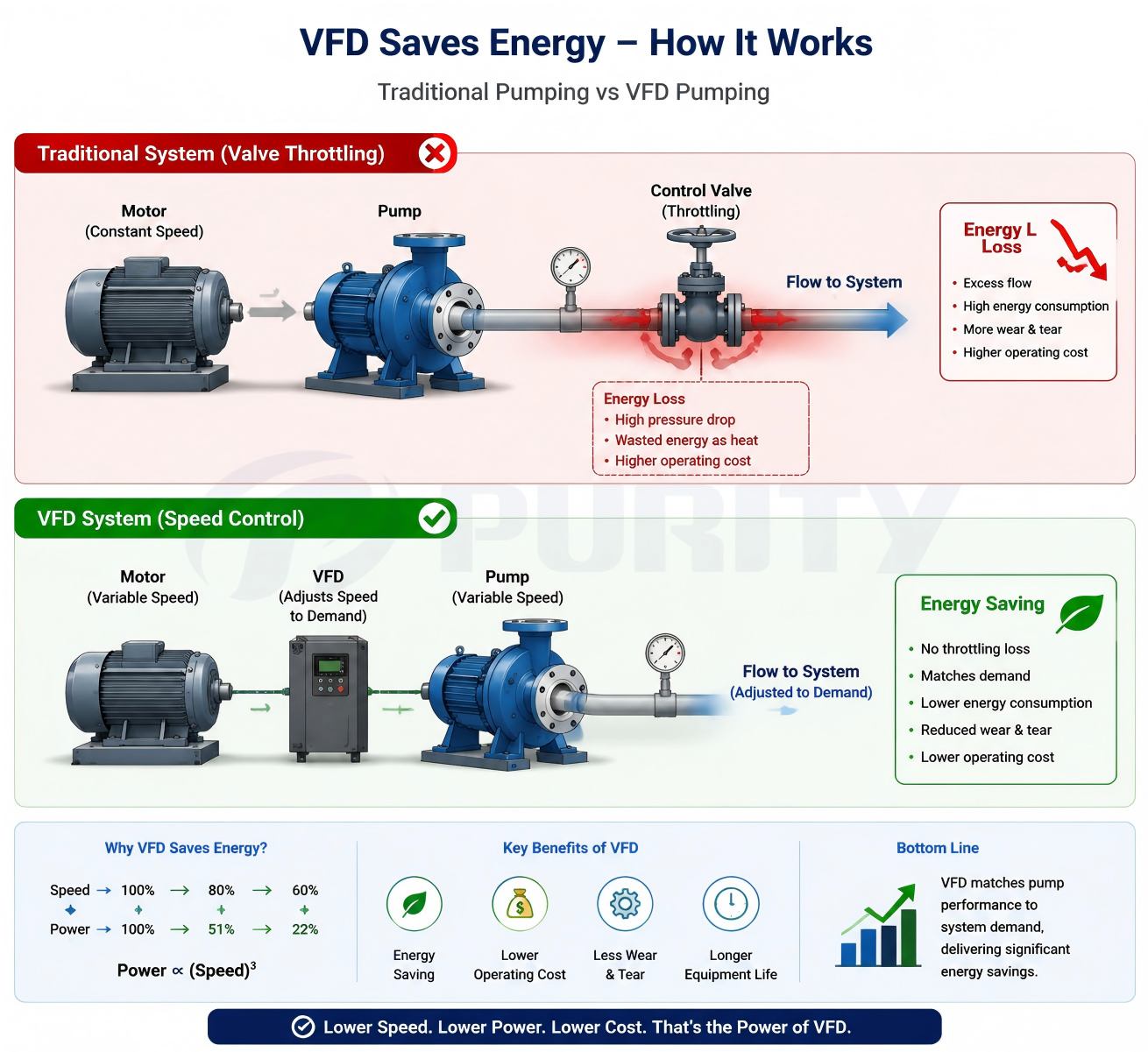
Picture|Centrifugal Pump VFD Saves Energy
In traditional systems, pumps run at constant speed regardless of demand. Excess flow is throttled back with a discharge valve — like driving with the accelerator floored while riding the brake.
A Variable Frequency Drive (VFD) eliminates this waste by matching motor speed to real-time demand:
| Benefit | How It Works | Typical Savings |
| Flow Control | Reduces pump speed instead of throttling | Eliminates valve energy losses |
| Soft Starting | Gradually ramps up motor speed, eliminating inrush current | Reduces motor wear and peak-demand charges |
| Affinity Law | Power consumption drops with the cube of speed reduction: P₂/P₁ = (N₂/N₁)³ | A 20% speed cut reduces power by nearly 50% |
The affinity law is the secret to VFD savings: small speed reductions deliver disproportionately large power cuts. Most industrial VFD retrofits pay for themselves within 12–18 months.
3. Impeller Trimming: Fixing Oversized Pumps
Many pumps are oversized during design — engineers add safety margins, and the next standard pump size ends up significantly larger than needed. An oversized pump runs permanently left of its BEP, wasting energy every hour.
Impeller trimming is a low-cost permanent fix. By machining the impeller diameter down to match the actual duty point, the pump’s performance curve shifts to intersect precisely with your system’s operating point. A 5–10% diameter reduction can bring a pump back to its BEP — restoring efficiency without replacing the unit.
4. Think Beyond the Pump: System Curve Optimization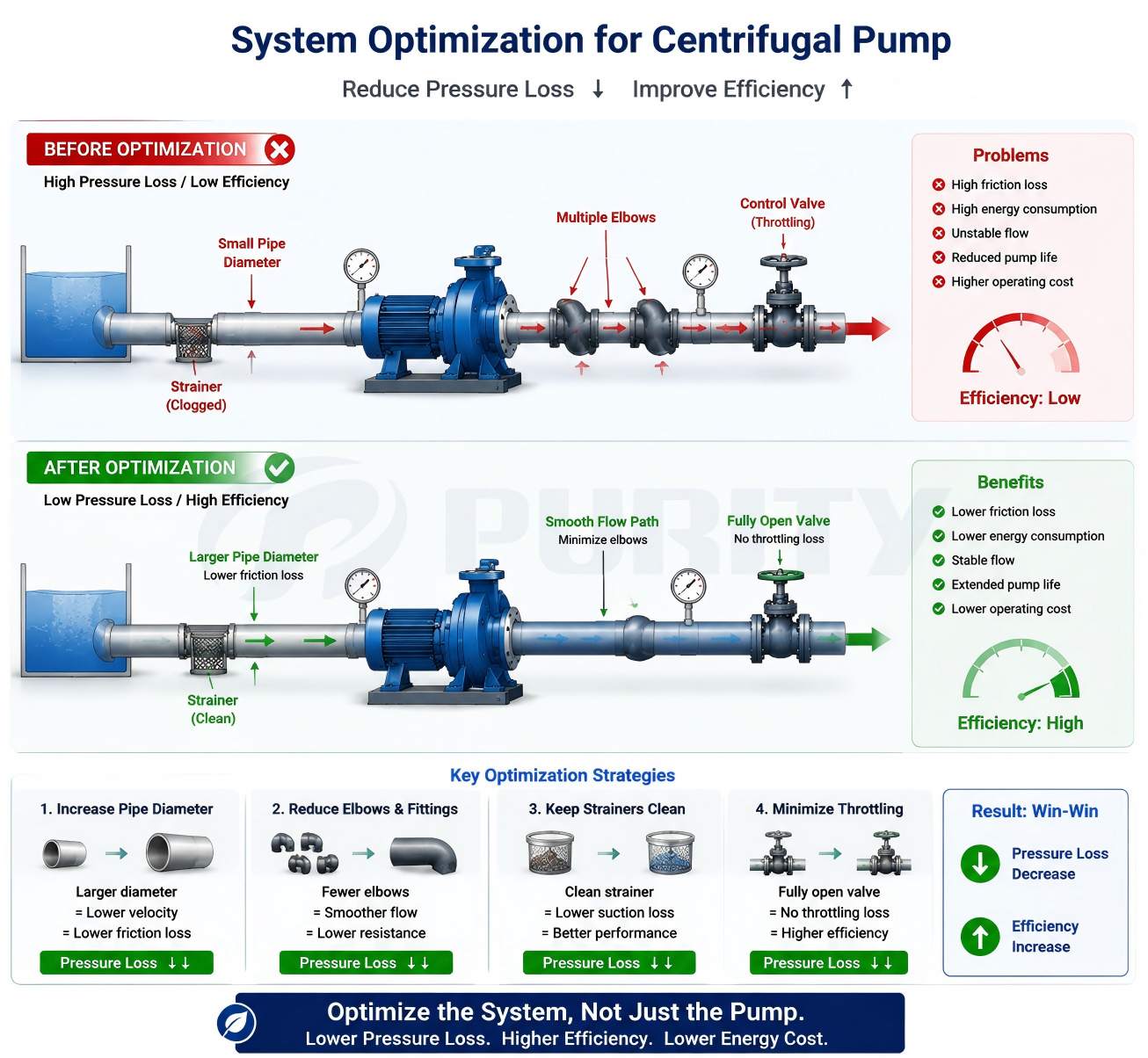
Picture|System Optimization for Centrifugal Pump
A pump operates against a system curve — the total resistance (static head plus friction losses) the piping imposes. Often, the biggest efficiency gains come from the system, not the pump:
(1)Oversize suction and discharge piping: Friction loss drops sharply with diameter. One size larger can cut losses by 30–50%.
(2)Eliminate unnecessary elbows: Every 90° bend adds resistance equal to several meters of straight pipe.
(3)Clean clogged strainers and filters: A blocked suction strainer wastes energy — a simple fix with instant payback.
5. Frequently Asked Questions
Q: How do I calculate VFD retrofit payback?
Compare current annual electricity cost (hours × kW × rate) against projected cost after VFD installation, using the affinity law for power reduction estimates. Most industrial retrofits achieve payback in 1–3 years.
Q: Can I trim an installed pump’s impeller?
Yes. The impeller is removed, machined on a lathe to the calculated diameter, dynamically balanced, and reinstalled. Always check the manufacturer’s minimum diameter limits first.
Q: What is wire-to-water efficiency?
Pump efficiency measures only hydraulic performance. Wire-to-water efficiency accounts for the entire system — motor, VFD, and transmission losses — giving the true end-to-end energy conversion ratio.
Energy-Efficient Solutions from Purity Pump
At Purity Pump , we engineer every centrifugal pump with lifecycle energy costs in mind. Our ISO-certified high-efficiency pumps operate closer to BEP, integrate seamlessly with VFDs, and deliver measurable savings in municipal, industrial, and HVAC applications across 130+ countries.
Contact Purity Pump’s engineering team for an energy audit, performance curve analysis, or VFD compatibility assessment.
Post time: Jul-23-2026


