
What Is a Centrifugal Pump Curve?
 Picture|Purity PS Performance Curve
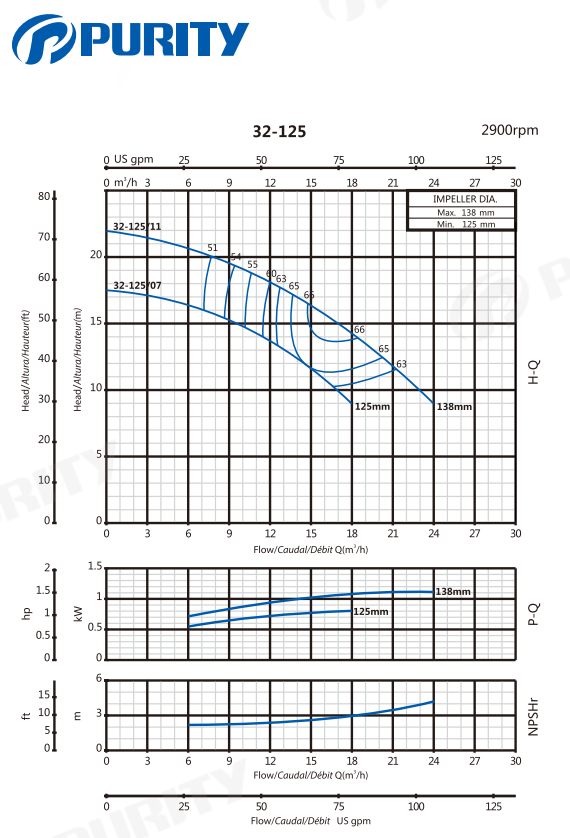
A centrifugal pump curve is a map. For every flow rate (Q) the pump can deliver, it shows the head (H) the pump produces at full speed. When that curve meets your system’s curve, you find the pump’s real operating point — and whether it fits your duty. Reading it before you buy takes two minutes — running off the best-efficiency point wastes energy and invites cavitation.
The Two Axes: Flow and Head
 Picture|Purity PS Performance Curve
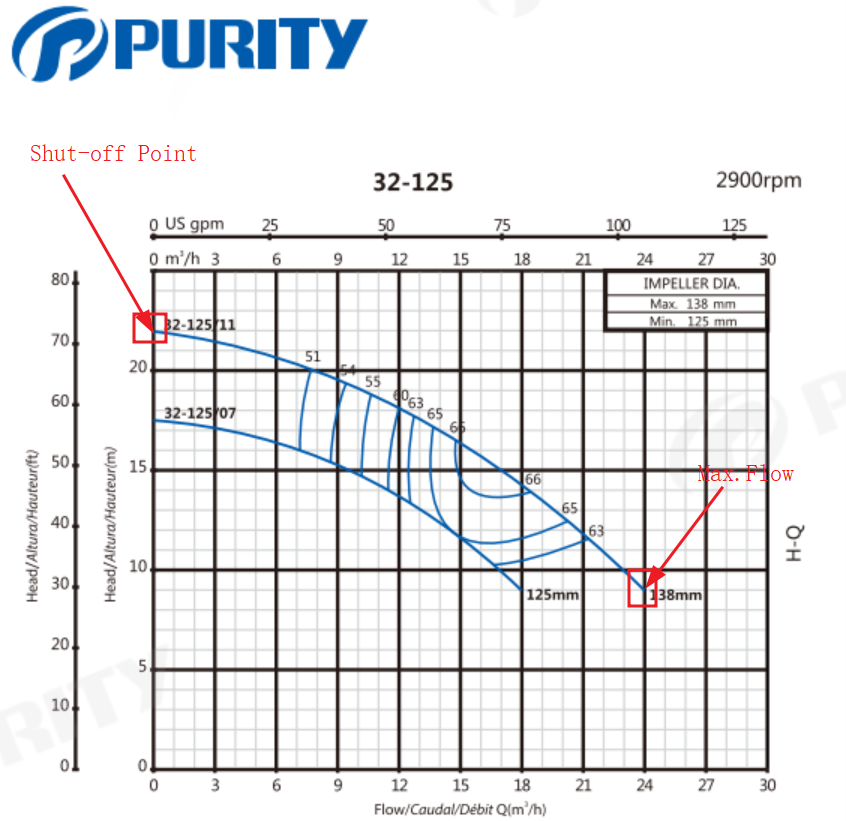
A pump datasheet plots flow Q (m³/h or GPM) horizontally against head H (meters) vertically. The line starts at the shut-off head — the maximum head at zero flow — and falls as flow rises, ending at run-out, the maximum flow at near-zero head. Curves use meters of head, not bar, because head is density-independent — the same pump lifts water or brine to the same height; only power changes. This is the layout on every Purity Pump datasheet, tested to ISO 9906.
Five Curves on a Datasheet
Picture|Purity PS Performance Curve
The Q–H line never travels alone. On our datasheets — and any reputable maker’s — five curves come as a set:
1.Q–H curve — the headline map of head vs. flow.
2.Efficiency curve — rises to a peak, the best efficiency point (BEP), then falls.
3.Power curve — shaft power absorbed, rising with flow; peaks near run-out.
4.NPSHr curve — required suction pressure, climbing steeply at high flow; cross below it and the pump cavitates.
5.Operating limits — minimum and maximum flow lines that mark the safe window.
The System Curve and Your Operating Point
Your pump works against your pipework, not in isolation. The system curve adds the static head (the physical lift) to friction losses, which rise roughly with the square of flow. Where the pump curve crosses the system curve is the operating point — the flow and head your installation actually achieves.
If the pump curve crosses above the system curve at your target flow, the pump overdelivers and should be throttled or trimmed; if it crosses below, it can never reach that flow. The right pump crosses at your duty with its BEP close to that flow — the whole art of selection, and the root of most field problems we diagnose.
Read It in Four Steps
1.Mark your duty — required flow and head on the same axes.
2.Find the operating point — check which pump curve passes through (or just above) that point.
3.Check the BEP position — the crossing should sit within about ±20% of the BEP flow. Far left means recirculation and overheating; far right means cavitation.
4.Verify NPSH and power — confirm NPSHa clears NPSHr at that flow and motor power covers the curve’s maximum, not just the duty point.
This is the exact sequence our engineers run when a customer sends us a duty point — duty plotted, operating point confirmed near BEP, NPSH and motor power checked against the published curve. It backs every Purity Pump quotation, free whether you buy from us or not.
Three Curve Mistakes We See in the Field
Since 2010, servicing pumps in 130+ countries, these are the curve mistakes we meet most often:
1.Buying oversized “for safety.” The pump runs far left of BEP, recirculating and overheating — oversized pumps fail sooner, not later.
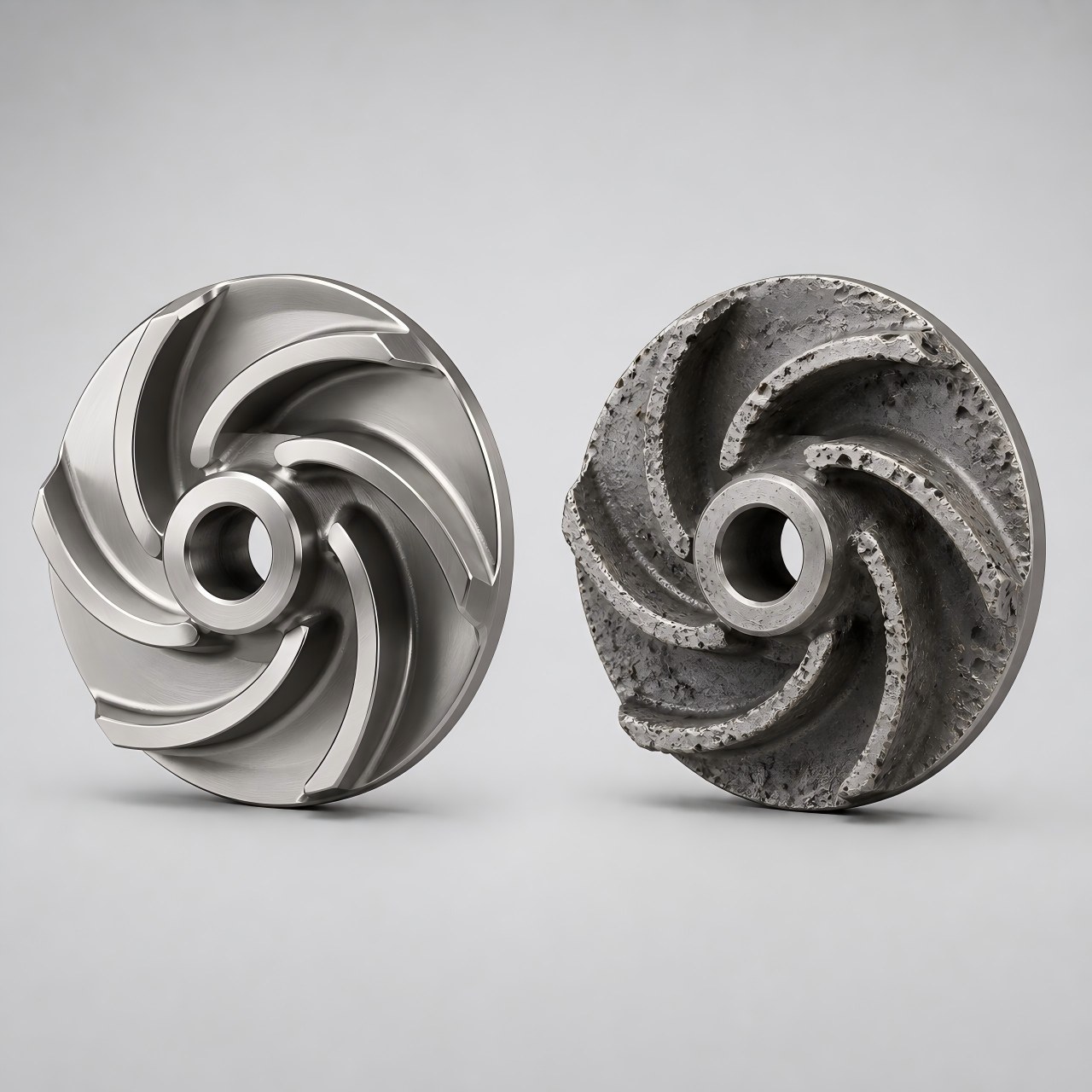
2.Ignoring the NPSHr line. The curve rises steeply at high flow; pushing a pump to its far right is the classic recipe for cavitation.
 Picture|Normal Impeller vs Cavitation-Pitted Impeller
3.Throttling a badly matched pump. A variable-frequency drive or impeller trim helps, but matching the curve at purchase is cheaper than fixing it after.
Frequently Asked Questions
1.What does BEP mean? Best efficiency point — the flow where the pump converts energy to work most efficiently. Every pump has exactly one; the duty point should live close to it.
2.Why does head fall as flow increases? Higher flow brings more velocity and friction inside the volute, so internal losses consume the impeller’s added pressure — hence the downward slope.
3.What is shut-off head? The head a pump produces at zero flow with the discharge valve closed — the top of the curve and the maximum pressure it can ever generate.
4.Do parallel and series pumps change the curve? Yes. Two pumps in parallel add flow at the same head; in series they add head at the same flow — both useful for variable demand.
5.Should I trust a pump with no published curve? No. A centrifugal pump without a Q–H curve is a guess. Every Purity Pump series ships with ISO-tested curves, from end-suction to multistage models — as any reputable maker should.
Still Unsure? Send Us Your Duty
Tell our engineers your required flow and head — we will plot them on the real curve and send the datasheet with your operating point marked, free of charge. Contact Purity Pump or start with the centrifugal pump range.
Sources
Wikipedia — Centrifugal pump
Engineering ToolBox — Centrifugal pumps
KSB — Centrifugal Pump Lexicon
Post time: Sep-10-2026


