
Direct Answer
Picture|Centrifugal Pump VS Gear Pump
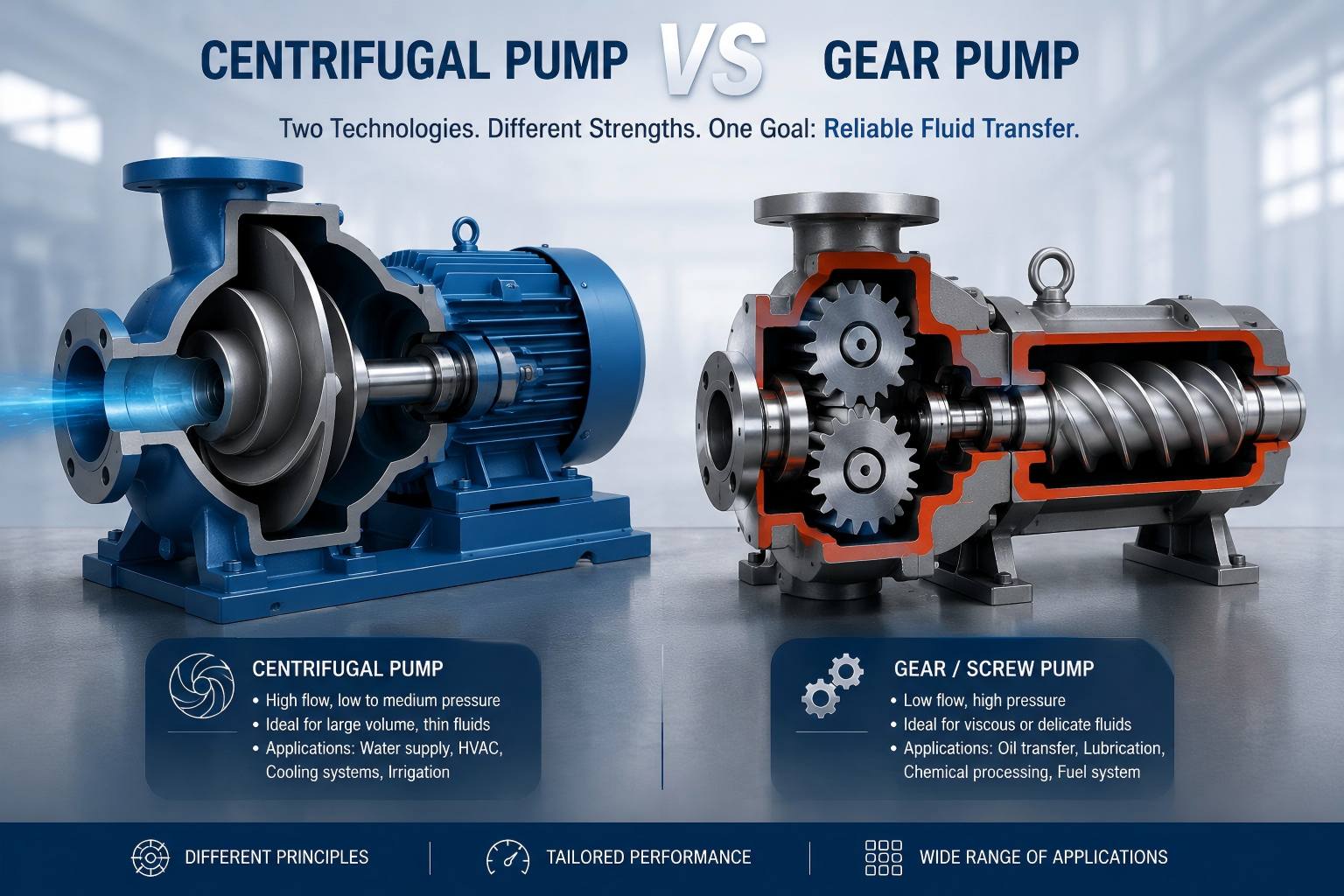
Moving clean water or thin liquids at high flow? Choose a centrifugal pump. Moving viscous fluids, slurries, or dosing at high pressure with low flow? Choose a positive displacement (PD) pump. A centrifugal pump adds velocity to the liquid and converts it into pressure; a PD pump traps a fixed volume every cycle and forces it into the discharge pipe.
Two Different Working Principles
 Picture|Centrifugal Pump VS Positive Displacement Pump
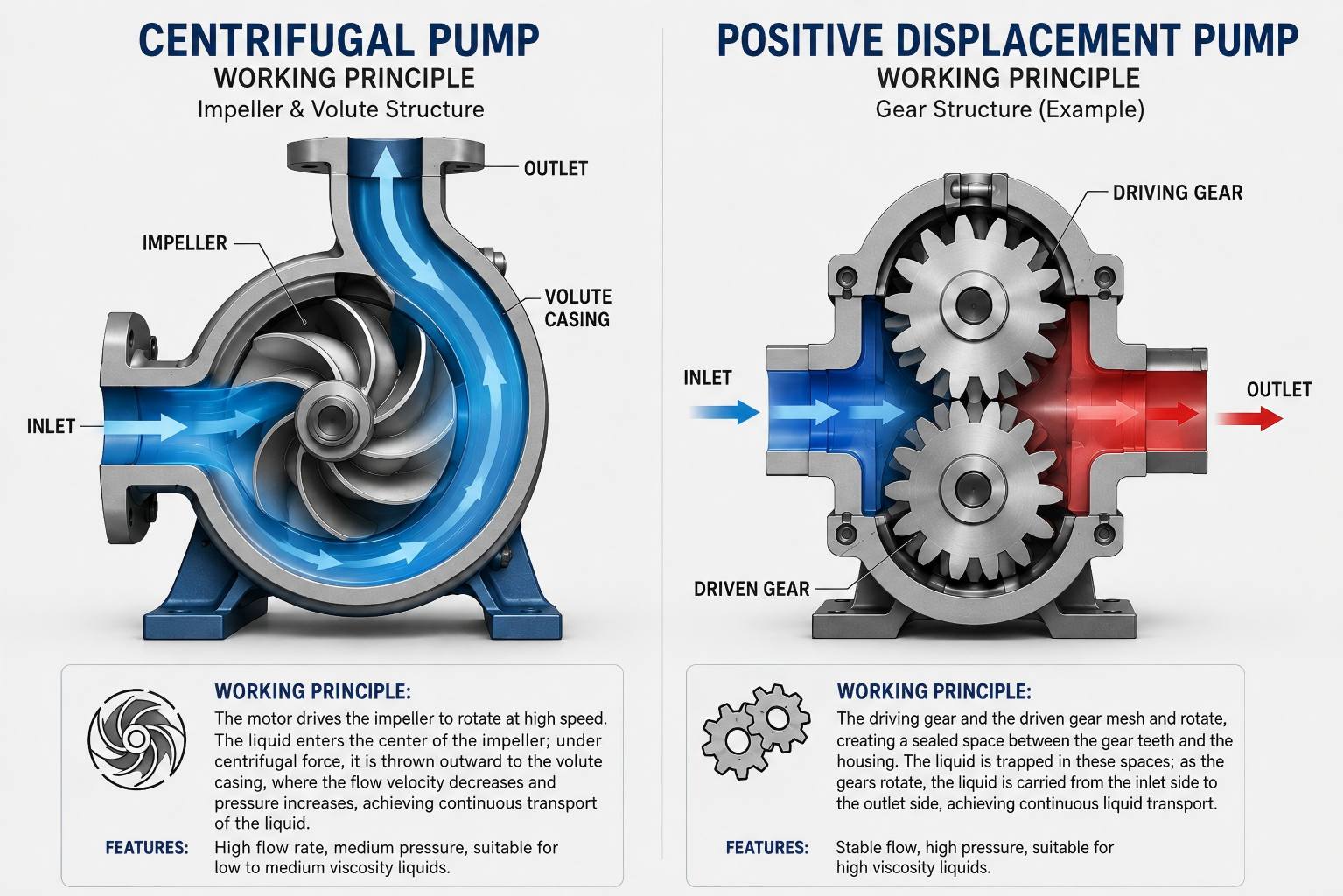
Centrifugal pumps are dynamic machines: a spinning impeller flings liquid outward and the volute converts that velocity into pressure. Flow changes with system resistance — throttling the discharge cuts delivery, up to a safe shut-off head.
Positive displacement pumps trap a fixed volume of liquid each cycle and displace it into the discharge line. A PD pump is a constant-flow machine — at a given speed it delivers nearly the same flow regardless of discharge pressure. But it must never run against a closed discharge valve: with no shut-off head, pressure climbs until a pipe bursts or the pump is damaged — always fit a relief valve. Common types: gear, screw, lobe and vane (rotary); piston, plunger and diaphragm (reciprocating).
Side-by-Side Comparison
| Factor | Centrifugal pump | Positive displacement pump |
| Working principle | Impeller adds velocity → volute turns it into pressure | Trapped volume forced into discharge each cycle |
| Flow vs. pressure | Flow falls as head rises (curve) | Nearly constant flow regardless of pressure |
| Max pressure (head) | Moderate per stage; add stages for more head | Very high possible (plunger, piston) |
| Viscosity | Best below ~50 cSt; efficiency drops fast | Handles thick fluids well; efficiency rises with viscosity |
| Solids | OK with non-clog impellers | Lobe/peristaltic types excel on slurries |
| Priming | Must be filled with liquid first | Most types self-prime |
| Closed discharge valve | Safe at shut-off head, but energy wasted | Forbidden — needs a relief valve |
| Maintenance | Few moving parts; simple | More wear parts: gears, valves, seals |
| Relative cost | Lower per unit of flow | Higher per unit of flow |
When to Choose a Centrifugal Pump
Choose centrifugal for clean or lightly contaminated liquids at high flow and low-to-medium head, running continuously:
Municipal water supply and booster systems
Fire protection
Agricultural irrigation
HVAC circulation
Sewage transfer with non-clog impellers
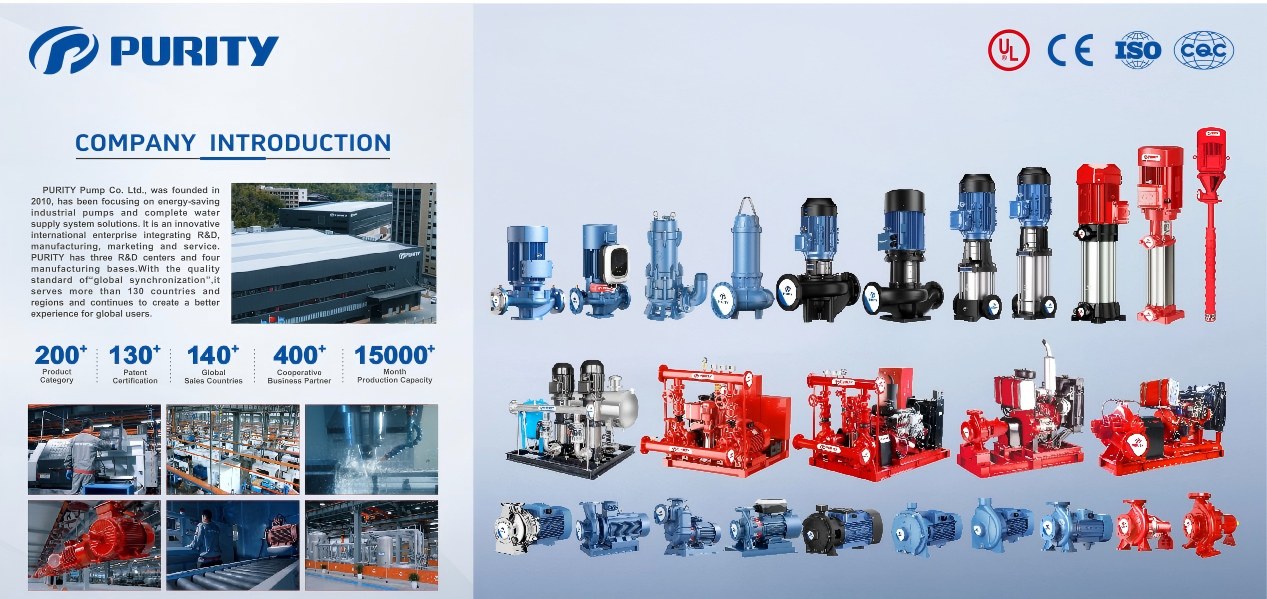
This is why the centrifugal family dominates water duty — and why Purity Pump builds its end-suction, double-impeller, multistage and stainless-steel series around it. Since 2010 our pumps have served 130+ countries, with UL, CE, SASO, CCC and CCCF certifications. See how each series works in our centrifugal pump guide.
 Picture|Purity Pump Company Introduction
When to Choose a Positive Displacement Pump
Choose PD when the liquid or the duty defeats a centrifugal:
Viscous fluids — oils, syrups, grease, resin: gear, screw or lobe pumps
High pressure, low flow — hydraulics, boiler testing: plunger or piston pumps
Accurate dosing — chemical metering: diaphragm pumps
Slurries and shear-sensitive liquids — food, pharmaceuticals, sludge: lobe or peristaltic pumps
A useful shorthand: if your liquid pours like water, think centrifugal; if it pours like honey or needs exact volume per stroke, think PD.
A straight answer from the maker: Purity Pump builds centrifugal pumps, not PD pumps. If your duty genuinely belongs to positive displacement, our engineers will say so and recommend the right specialist rather than oversell a pump that underdelivers.
A 3-Question Quick Test
What is the liquid? Clean or slightly dirty water → centrifugal. Viscous, abrasive or slurry → PD.
What flow and pressure? High flow with moderate head → centrifugal. Low flow against very high pressure → PD.
How does it run? Continuous duty → centrifugal; intermittent dosing or metering → PD.
Frequently Asked Questions
Why can’t a PD pump run against a closed valve? A PD pump has no shut-off head — it keeps pushing volume until pressure bursts a pipe or breaks the pump. Fit a relief valve.
Which pump type is more efficient? On thin liquids at its best-efficiency point a centrifugal pump reaches 85%+. PD pumps win on viscous and low-flow, high-pressure duties where centrifugal efficiency collapses.
Do positive displacement pumps need priming? Most PD types can lift liquid from a dry start; a centrifugal pump must be filled with liquid first.
Why are fire pumps always centrifugal? Fire protection needs high flow at moderate pressure — the centrifugal sweet spot — so industry standards assume centrifugal machines.
I need to transfer diesel — centrifugal or PD? Low-viscosity fuels at high flow suit centrifugal pumps; for lubricating oil or very high delivery pressure, use a gear or screw PD pump.
Still Unsure? Ask a Pump Engineer
Send our engineers the liquid, flow and head — the fluid alone usually settles the debate. Contact Purity Pump for a free duty-point check, or browse the centrifugal pump range.
Sources
Wikipedia — Centrifugal pump
Wikipedia — Positive displacement pump
Engineering ToolBox — Centrifugal pumps
Engineering ToolBox — Positive displacement pumps
KSB — Centrifugal Pump Lexicon
Post time: Sep-02-2026

